Sensor Suhu Bearing Presisi – Deteksi & Pemantauan Akurat
Bearing Temperature Sensor / Detector
BearingTemperature Sensor is also Known or called as Bearing Temperature Detector (BTD ).
It is Shortly known as BTD.
First ,we know about what is Temperature Sensor ?
Temperature sensor is an instrument or a device used for measuring temperature of any things or places.
Suggest read :- Scavenge fire
Working of Temperature Sensors
As we know that temperature sensors senses temperature of any things or any places by two method either by direct contact of heating source or remotely , without direct contact of heating source with radiated heat energy.
Indirect method of temperature sensors require two functions or variables.
Sensing elements have repeatable resistance /voltage / current versus temperature relationship (R vs T) and operating temperature range.
The R/V/A vs T relationship is defined as amount of resistance/voltage/current change of sensor per degree of temperature change.
Let us in different way
Change in first function ,occurs due to radiation energy if heat source.
And this first function is directly proportional to change in temperature.
First function may be voltage, current and resistance etc.
Today, a wide range of temperature sensors, including thermocouples, resistance temperature detectors (RTDs), thermistors, infrared and semiconductor sensors, are available on the market.
Inside temperature sensors ,For measuring temperature RTD is used which is made by wrapping fine wire around ceramic or glass.
Generally,For RTD elements platinum, Copper,Nickel,or Cadmium is used and having repeatable resistance relationship versus temperature ( R vs T ) and operating temperature range.
The thermocouple is also used inside temp. Sensor and which us made up of two different materials and it did work of generating voltage when there is change in temperature.
Voltage is directly proportional to temperature .It means when there is increase in Temperature then voltage also increased and similarly when there is decrease in temperature then voltage also decreased.
What is Bearing Temperature Sensors/ Detectors ?
Bearing Temperature Sensors or Detectors is type of Temperature sensors which is used for measuring temperature of Bearing.
Where Bearing Temperature Sensors / Detector located ?
As we know that bearing has mainly two parts
1.Stationary and
2.Rotary
Bearing Temperature Sensors / Detectors are installed at stationary bearing casing and did work of monitoring temperature of bearings.
Bearing Temperature Installation
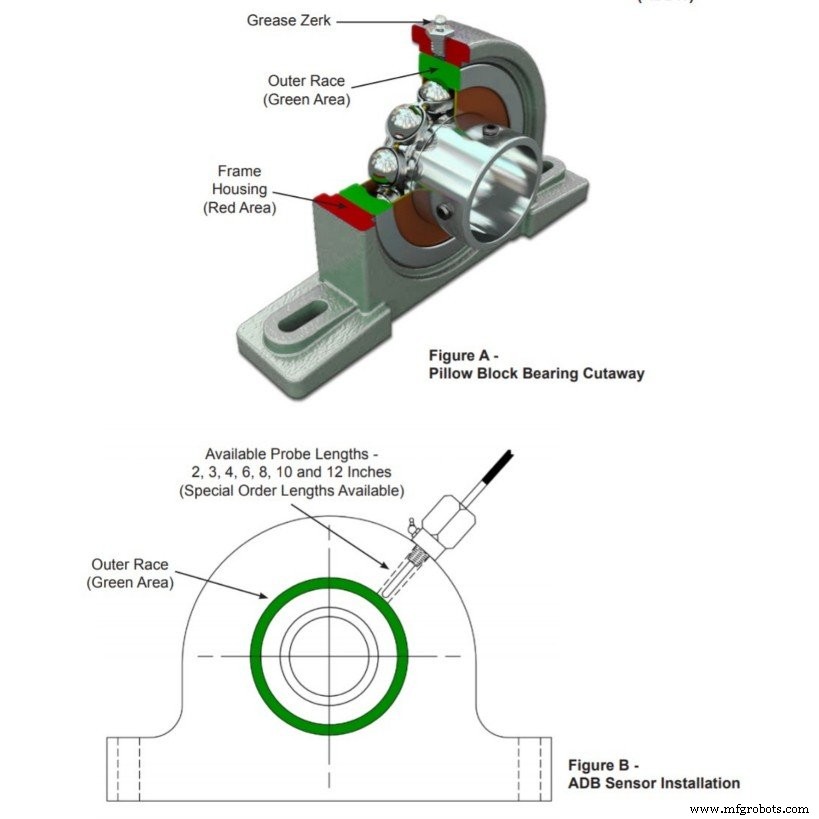
Remove existing grease zerk from bearing housing.
Loosen ADB probe nut and remove sensor probe.
Screw ADB sensor body in to 1/8” NPT threaded hole in bearing housing.
Re-insert temperature probe into sensor body, and adjust probe depth to suit bearing. For optimum temperature monitoring, probe should be as close to outer race as possible without touching (Figures A and B).
Tighten ADB probe nut using recommended wrench (ADBW). The maximum recommended torque for probe nut is 18 in lb (2 Nm).
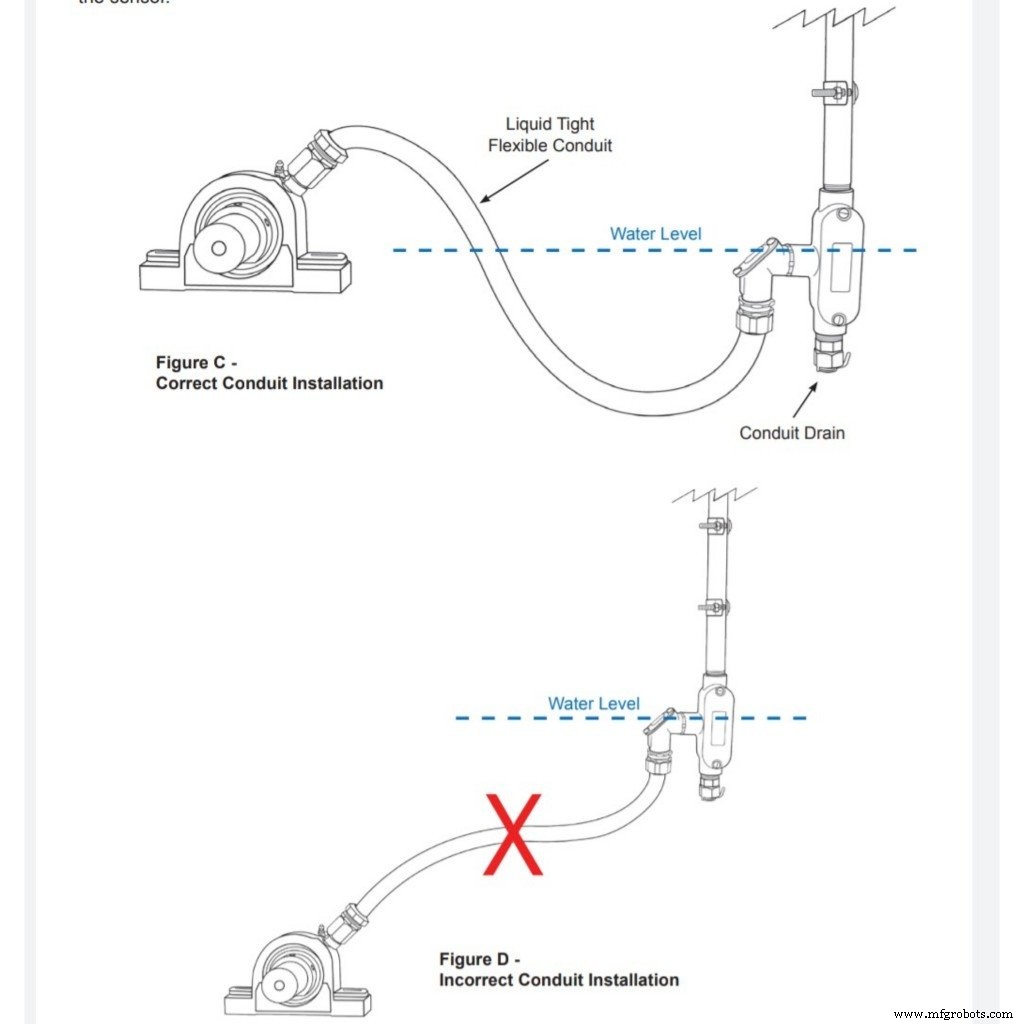
It is important to use liquid tight flexible conduit and fittings for the installation (Figures C and D) to protect sensor cables.
LIQUID TIGHT FLEXIBLE CONDUIT INSTALLATION
Conduit systems can channel water directly to sensors from incorrectly sealed fittings and condensation.
Over time, water will adversely affect sensor performance. To prevent this type of damage, it is important to properly install conduit and low point conduit drains.
Use rigid metal conduit to protect cables from sensors to control unit.
Figure C illustrates correct installation of liquid tight flexible conduit. Notice that bearing sensor is above conduit drain and water level.
Figure D shows that water, particularly condensation, can bypass conduit drain and flow directly into sensor.
SKF Bearing Sensor Unit
What is an SKF Sensor Bearing Unit ? SKF Sensor-Bearing Units are mecha-tronic machine components covering fields of both sensor and bearing engineering.
They are virtually ideal combination of versatile deep groove ball bearings with sensor units shielded from external influences.
Sensor body, impulse ring and bearing are mechanically attached to each other,forming integral ready-to-mount
SKF Sensor-Bearing Units used for recording ● number of revolutions ● speed ● direction of rotation ● relative position/counting ● acceleration or deceleration
Apart from these bearing units with speed sensors,bearing units with temperature sensors are also from SKF.They allow immediate and permanent monitoring of bearing temperature,preventing hot-running axle boxes and bearing damage in operations.
Skf Bearing Temperature sensor
As we know that Bearing Temperature Sensors is sensor used for measuring temperature of Bearings.
SKF Bearing Temperature Sensor is also type of sensor used for measure bearing temperature.As it is made by Company SKF so it’s name SKF BTD sensors.
Generally,we use pt100 RTD sensors for measuring Bearings Temperature.
Adjustable pt100 skf Bearing sensors with grease Nipple type SKF PT100K3DN
SKF PT100K3DN has a special feature that is adjustable in terms depth of probe approach. This temperature sensor has been specially designed for SKF bearings.
In practice, differences of about 20% to 40% to act against surface temperature measurements. This can quickly interfere at rise of temperature.
PT100 delivers permanent standby signal. If there is no such signal, cause for this must be investigated and if possible, PT100 sensor must be replaced.
As long as PT100 emits standby signal, it also emits emergency contact signal due to rising temperature, as soon as there is friction that can cause harm to machine and can cause heat, fire.
Analogue signal sensors can be connected directly to PLC or to increase protection of independent monitoring device, such as GSI48 indicator.
Analogue signal can also be converted to digital, profibus signal by transmitter.
Skf Bearing Temperature Limit
ATEX Classification version (Ex-i) III 1/2 D Ex ia IIIC TX Da/Db, II 1/2 G Ex ia IIC T6..T1 Ga/Gb -40°C tot 185°C
SKF Bearing Temperature limit is 185 degree Celsius.
Bearing Temperature Sensor pt100
Bearing Temperature Sensor pt100 is RTD sensor which used platinum for Resistance.
Pt100 is common type of RTD sensor whose sensing elements made up of platinum.
By far,Pt 100 is common RTD sensor used for measuring temperature of bearing which have nominal resistance of 100 ohms at 0 degree Celsius.
Pt symbol is used for platinum and “100” is for Resistance in Ohm at 0 degree Celsius.
Similarly pt 1000 sensors ,pt for platinum and “1000” is for resistance in ohms at 0 degree Celsius.
Resistance / Temperature relationship for metal
Typically RTD sensing elements made of platinum, copper or nickel have repeatable resistance to temperature (R vs T) and operating temperature range.
R vs. T relationship is defined as sensor’s amount of resistance change per degree of temperature change.
Relative resistance change (resistance coefficient of temperature varies only slightly across sensor’s useful range.
Bearing Temperature Sensors / Detector working principle
As we read above that temperature sensors senses temperature of any things or any places by two method either by direct contact of heating source or remotely , without direct contact of heating source with radiated heat energy.
BTDs sense temperature without touching bearing because due to rotation there is risk of damage of sensors.
Bearing temperature detectors working principle is that one variables connection with heating source via infrared ( Resistance,current,voltage )is directly proportional to temperature.
It uses two functions or variables
One function indirectly connection with measuring elements by infrared and second functions is temperature.
As there is change first functions of BTDs then temperature also change.
Let us understand by example
Bearing RTD Sensor
RTD Sensor is type of Sensor which contains sensing element whose resistance change with change in temperature.
It is Usually made of platinum, but nickel or copper devices are not uncommon.
In today use , RTDs can take several different forms, such as wire wound, thin film.
To measure resistance across RTD, apply constant current, measure resulting voltage, and determine resistance of RTD.
Working of RTD
RTD consists of certain metallic elements whose resistance change is temperature phenomenon.
Small excitation current is passed through element during operation, and voltage, proportional to resistance, is then measured and converted to temperature calibration units.
RTD element is created by winding wire (wire wound elements) or plating film (thin film elements) on core of ceramic or glass and sealing element within capsule of ceramic or glass.
Bearing Thermocouple
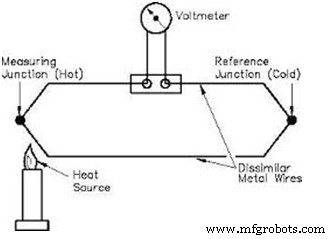
Thermocouple consists of welded ‘hot’ junction, usually wires, between two separate metals, and reference junction at opposite ends of parent materials.
Joint end is referred to as HOT JUNCTION. Cold END or COLD JUNCTION is other end of these dissimilar metals.
Cold junction is at last end of thermocouple material .
Between hot junction and cold junction,if there is difference in temperature then small voltage ic created
Temperature changes at measurement junction cause electromotive force (emf) between other ends to shift.
Across free ends of thermocouple wires, EMF appears where it is measured and converted into heat calibration units.
Note:-To measure temperatures from -400 °F to 1550 °F, Platinum RTDs are used. RTDs are slowly replacing use of thermocouples in many industrial applications below 1200 ° F due to improved precision and repeatability.