Tampilan Cahaya & Suara Arduino: Lagu Kebangsaan AS
Komponen dan Perlengkapan
Arduino Nano R3
Perhatikan ini memiliki 4 prosesor berbeda saya menggunakan 328P (bootloader lama)
×
1
Buzzer
Buzzer apapun boleh saya menggunakan buzzer 16 Ohm.
×
1
Tombol Push SparkFun 12mm
Tidak harus sama yang saya tapi milik saya 6x6x6mm
×
2
Saklar Beroncot 250V 3A
Saklar daya apapun boleh. Saya menggunakan kotak 9Volt dengan saklar tapi tersembunyi di kotak saya jadi saya menambahkan saklar ke luar. Cari saklar beroncot apapun.
×
1
Resistor 330 ohm
Resistor apapun akan bekerja tapi hitung LED dan pastikan tidak melebihi output LED atau 40 mA maks per pin Nano. 330 ohm cukup standar dalam starter pack Arduino.
×
3
LED (generik)
6 LED atau sebanyak yang Anda inginkan. 2 merah, 2 putih dan 2 biru. LED merah yang saya gunakan 2.2V dan 3 yang lain 3.2V masing-masing LED. Hasilnya 9.7mA & 6.7 mA menggunakan 330 ohm. (ingat saya menggunakan 2 per output jadi ~13 mA & ~20mA yang separuh dari arus output maks pin)
×
6
SparkFun Solder-able Breadboard - Mini
Breadboard apapun akan bekerja, solder atau tidak terserah Anda bagaimana tampilannya. Atau Anda dapat melakukannya tanpa satu pun dan cukup lubang bor dan kayu dan leleh panas bagian-bagian di tempat.
×
1
Baterai 9V (generik)
banyak opsi daya. Saya menggunakan baterai 9 volt dengan kotak dan saklar. Anda dapat menggunakan kabel USB saja atau bahkan pak baterai 4x AA selama Anda memenuhi persyaratan input Nano. Saya menyesali membayar lebih untuk yang memiliki saklar on/off karena saya menggunakan saklar terpisah.
×
1
Alat dan Mesin yang Diperlukan
Pakuin solder (generik)
Terserah Anda apakah ingin menyolder
Tentang Proyek Ini
Saya telah memulai selama tahun terakhir melakukan pemrograman untuk proyek lampu dan musik Natal nanti. Ini adalah proyek sampingan yang diminta seseorang dan saya pikir akan menyenangkan. Awalnya ini hanya akan menjadi satu lagu dengan lampu tapi itu malas.
Berikut adalah tautan jika Anda mengalami masalah dengan video:
https://youtu.be/C2jyn80Mjus
Proyek ini menggunakan Arduino Nano. Dalam proyek ini saya menggunakan dua tombol push yang berbeda untuk dua lagu yang berbeda menggunakan fungsi Tone(). Satu adalah suara 'charge' dan yang lainnya adalah 'US National Anthem'. Sampai tombol ditekan ia melakukan beberapa lighting acak untuk efek.
Dalam sketsa ini saya menggunakan banyak fungsi untuk menyederhanakan proses penulisan fungsi saya tetapi mempertahankan kontrol penuh proses lighting/sound jadi saya dapat melakukan penyesuaian kecil jika saya tidak suka apa yang saya dengar/lihat dengan sangat sedikit kesulitan.
Tujuan saya memposting proyek ini adalah untuk berbagi beberapa hal yang telah saya pelajari dalam desain/koding sehingga jika Anda melakukan sesuatu yang serupa ini dapat membantu.
Berikut adalah tampilan desain awal pada breadboard saat saya menguji sistem dan kode.
Berikut adalah tampilan sistem daya. Saya memilih baterai 9Volt untuk ukuran dan tidak bergantung pada dinding USB atau daya komputer.
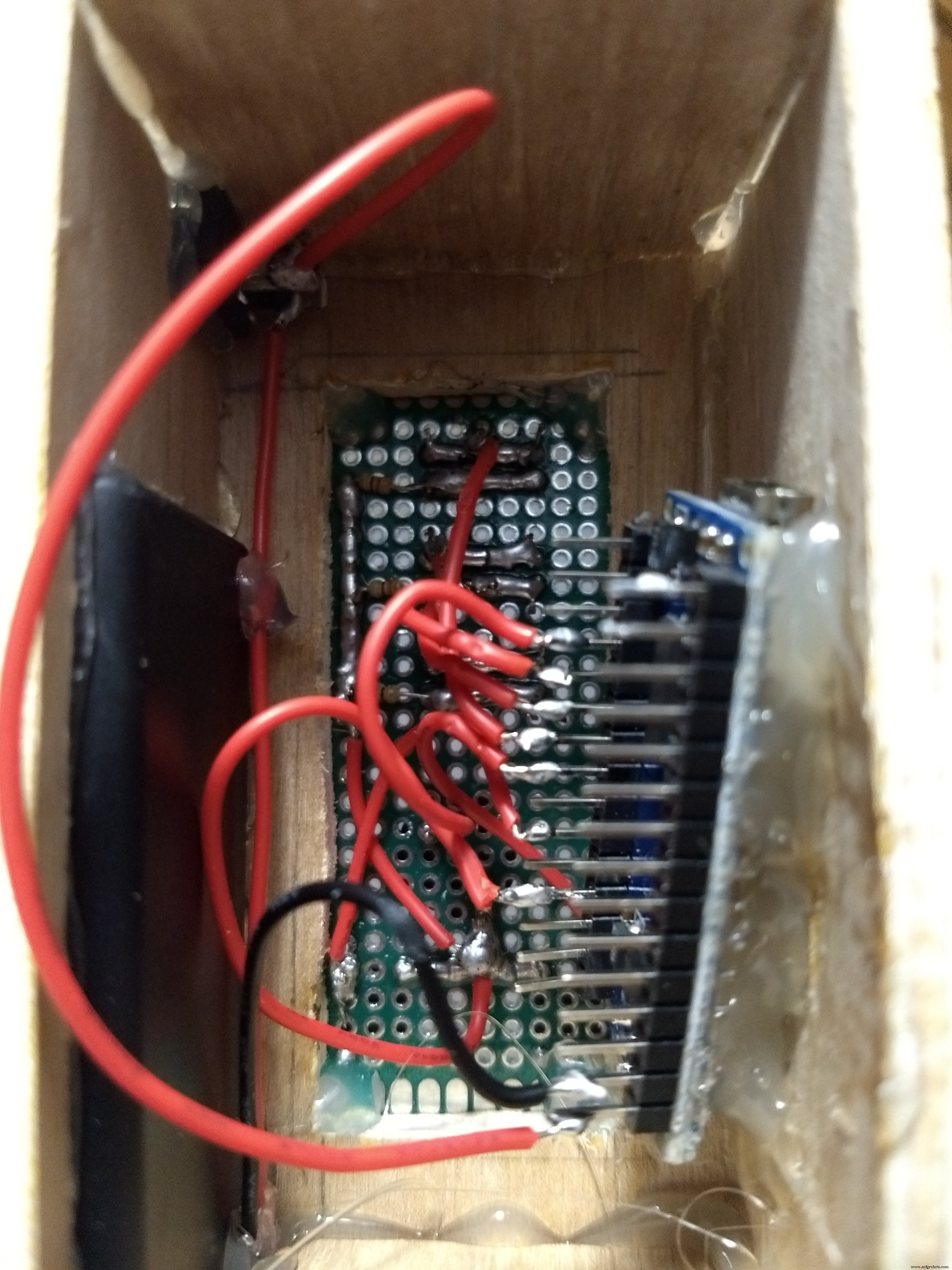
Ini tampilannya setelah semuanya disolder dari dalam. Sangat disarankan untuk menyolder dengan hanya tutup atas lalu menambahkan sisi kemudian
Kode
USA_ANTHEM_Updated.ino
USA_ANTHEM_Updated.inoArduino
The Star Spangled Banner dengan LEDs, Charge, tone, semua fungsi. Cukup salin dan tempel.
/*Star Spangled Banner with LEDs Created by Ryan Aebi June 2018 Code Structure -Basic Loop to refernce other functions -Push buttons do either Star Spangled Banner or Charge sounds with lights Star Spangled Banner Notes -Funtion has note assigned by integer for Frequncy(Hz), & duration(time in n) -LED is choosen by myself semi-randomly when writing function -Function is built to increase in pitch with each play (resets to normal pitch on startup/hardware reset) -Pitch calculated is 1/12 of a whole or .06 Button Design/wiring -3 LED sets of Red, Blue & Green on each channel including 2 of each in parallel. -External reset button -start button for song -interrupt song for charge */ //**************************************************************Declared Integers const int ChargeButton=3; //(Nano D3) uno pin 2 should be an interupt pin const int StartButton=5; //(Nano D5) uno pin 4 const int BuzzerPin=9; //(Nano D9) uno pin 9 const int RedLED=6; //(Nano D6) uno pin 6 const int WhiteLED=7; //(Nano D7) uno pin 7 const int BlueLED=8; //(Nano D8) uno pin 8 int n=1000; //declaring the integer this value will change with each song int DurationOn=n; //declaing integer for later on will be used in stacatto calculations int DurationRest=n; //declaing integer for later on will be used in stacatto calculations //sum of x & y should be 1 I have more notes on this later on float x=.66; //declaring float for time on float y=.34; //declaring float for time off //rate at which lights randomly flash while waiting button input int Twinkle_Rate=250; //note that if increased drastically buttons may not respond 100% of the time //lower twinkle rate improves button press response //sets integers for button states int StartButtonState; int ChargeButtonState; //note middle C is 4C (B flats & E flats) int Note1=233; //3Bb 233Hz int Note2=294; //4D 294Hz int Note3=330; //4E 330Hz int Note4=349; //4F 349Hz int Note5=392; //4G 392Hz int Note6=440; //4A 440Hz int Note7=466; //4Bb 466Hz int Note8=523; //5C 523Hz int Note9=587; //5D 587Hz int Note10=622; //5Eb 622Hz int Note11=698; //5F 698Hz //**************************************************************Charge Function/Song void Charge(){ n=600; //rate at which song progresses //Format: write pin(s) on, tone at specific frequency (this way its not subject to //changes at end of National Anthem, more on this later on), delay for same time as tone to sync up music, //write pin(s) off that were on and delay for a rest digitalWrite(RedLED, HIGH); tone(BuzzerPin, 392, n/3); delay(n/3); digitalWrite(RedLED, LOW); delay(70); digitalWrite(WhiteLED, HIGH); tone(BuzzerPin, 523, n/3); delay(n/3); digitalWrite(WhiteLED, LOW); delay(70); digitalWrite(BlueLED, HIGH); tone(BuzzerPin, 659, n/3); delay(n/3); digitalWrite(BlueLED, LOW); delay(70); digitalWrite(RedLED, HIGH); digitalWrite(WhiteLED, HIGH); digitalWrite(BlueLED, HIGH); tone(BuzzerPin, 784, n*3/4); delay(n*3/4); digitalWrite(BlueLED, LOW); digitalWrite(RedLED, LOW); digitalWrite(WhiteLED, LOW); delay(70); digitalWrite(BlueLED, HIGH); tone(BuzzerPin, 659, n/4); delay(n/4); digitalWrite(BlueLED, LOW); delay(70); digitalWrite(RedLED, HIGH); digitalWrite(WhiteLED, HIGH); digitalWrite(BlueLED, HIGH); tone(BuzzerPin, 784, n*2); delay(n*2); digitalWrite(BlueLED, LOW); digitalWrite(RedLED, LOW); digitalWrite(WhiteLED, LOW); delay(70); } //**************************************************************SingleDW function void SingleDWwithNote(int HZ, int TurnOn, int Duration, int Staccato){ //Hertz at which note is (references Note#) //turn on= pin (red/white/blue LED) that will be tuned on //duration is for how long //Staccato 1=yes, 0=no results in slightly shortened note, or a high int x value as just a brief pause if (Staccato==1){DurationOn=Duration*x;} //how long tone & lights are on is DurationShort else if (Staccato==0){DurationOn=Duration;} digitalWrite(TurnOn, HIGH); tone(BuzzerPin, HZ, DurationOn); delay(DurationOn); digitalWrite(TurnOn, LOW); if (Staccato==1) { DurationRest=Duration*y; delay(DurationRest); } } //**************************************************************USA National Anthem Function/Song void USNationalAnthem(){ n=577; //rate at which sound plays calulated from: 60,000 (ms/BPM factor) / 104 BPM = 577 ms /* quarter note value is n half note value in n*2 eighth notes it n/2 dotted eights note is n*3/4 */ //x & y integers are for staccato/adding rest after a note //note that x+y must =1 or the int. n rate will be thrown off //decrease x and increase y though to make the notes more pronouced and jumpy/upbeat x=.92; //true stacatio is about 1/2 or 2/3 value so x value around .5 to .7 for a true staccato y=.08; //1.00-.92(x value) =.08 //bars 1-5, lines 1 SingleDWwithNote(Note4, RedLED, n*3/4, 1); SingleDWwithNote(Note2, WhiteLED, n/4, 1); SingleDWwithNote(Note1, RedLED, n, 1); SingleDWwithNote(Note2, WhiteLED, n, 1); SingleDWwithNote(Note4, RedLED, n, 1); SingleDWwithNote(Note7, WhiteLED, n*2, 1); SingleDWwithNote(Note9, BlueLED, n*3/4, 1); SingleDWwithNote(Note8, WhiteLED, n/4, 1); SingleDWwithNote(Note7, RedLED, n, 1); SingleDWwithNote(Note2, WhiteLED, n, 1); SingleDWwithNote(Note3, BlueLED, n, 1); SingleDWwithNote(Note4, RedLED, n*2, 1); SingleDWwithNote(Note4, RedLED, n/2, 1); SingleDWwithNote(Note4, RedLED, n/2, 1); //bar6-9 line 2 SingleDWwithNote(Note9, BlueLED, n*3/2, 1); SingleDWwithNote(Note8, WhiteLED, n/2, 1); SingleDWwithNote(Note7, RedLED, n, 1); SingleDWwithNote(Note6, BlueLED, n*2, 1); SingleDWwithNote(Note5, WhiteLED, n/2, 1); SingleDWwithNote(Note6, BlueLED, n/2, 1); SingleDWwithNote(Note7, RedLED, n, 1); SingleDWwithNote(Note7, RedLED, n, 1); SingleDWwithNote(Note4, BlueLED, n, 1); SingleDWwithNote(Note2, WhiteLED, n, 1); SingleDWwithNote(Note1, BlueLED, n, 1); SingleDWwithNote(Note4, RedLED, n*3/4, 1); SingleDWwithNote(Note2, WhiteLED, n/4, 1); //bars 10-13 line 3 SingleDWwithNote(Note1, RedLED, n, 1); SingleDWwithNote(Note2, WhiteLED, n, 1); SingleDWwithNote(Note4, RedLED, n, 1); SingleDWwithNote(Note7, WhiteLED, n*2, 1); SingleDWwithNote(Note9, BlueLED, n*3/4, 1); SingleDWwithNote(Note8, WhiteLED, n/4, 1); SingleDWwithNote(Note7, RedLED, n, 1); SingleDWwithNote(Note2, WhiteLED, n, 1); SingleDWwithNote(Note3, BlueLED, n, 1); SingleDWwithNote(Note4, RedLED, n*2, 1); SingleDWwithNote(Note4, RedLED, n/2, 1); SingleDWwithNote(Note4, RedLED, n/2, 1); //bar 14-17, line 4, end of page 1 SingleDWwithNote(Note9, BlueLED, n*3/2, 1); SingleDWwithNote(Note8, WhiteLED, n/2, 1); SingleDWwithNote(Note7, RedLED, n, 1); SingleDWwithNote(Note6, BlueLED, n*2, 1); SingleDWwithNote(Note5, WhiteLED, n/2, 1); SingleDWwithNote(Note6, BlueLED, n/2, 1); SingleDWwithNote(Note7, RedLED, n, 1); SingleDWwithNote(Note7, RedLED, n, 1); SingleDWwithNote(Note4, BlueLED, n, 1); SingleDWwithNote(Note2, WhiteLED, n, 1); SingleDWwithNote(Note1, RedLED, n, 1); SingleDWwithNote(Note9, BlueLED, n/2, 1); SingleDWwithNote(Note9, BlueLED, n/2, 1); //bars 18-21, line 5, start of page 2 SingleDWwithNote(Note9, BlueLED, n, 1); SingleDWwithNote(Note10, RedLED, n, 1); SingleDWwithNote(Note11, WhiteLED, n, 1); SingleDWwithNote(Note11, WhiteLED, n*2, 1); SingleDWwithNote(Note10, RedLED, n/2, 1); SingleDWwithNote(Note9, BlueLED, n/2, 1); SingleDWwithNote(Note8, WhiteLED, n, 1); SingleDWwithNote(Note9, BlueLED, n, 1); SingleDWwithNote(Note10, RedLED, n, 1); SingleDWwithNote(Note10, RedLED, n*2, 1); SingleDWwithNote(Note10, RedLED, n, 1); //bars 22-25, line 6 SingleDWwithNote(Note9, WhiteLED, n*3/2, 1); SingleDWwithNote(Note8, BlueLED, n/2, 1); SingleDWwithNote(Note7, WhiteLED, n, 1); SingleDWwithNote(Note6, RedLED, n*2, 1); SingleDWwithNote(Note5, BlueLED, n/2, 1); SingleDWwithNote(Note6, RedLED, n/2, 1); SingleDWwithNote(Note7, WhiteLED, n, 1); SingleDWwithNote(Note2, BlueLED, n, 1); SingleDWwithNote(Note3, RedLED, n, 1); SingleDWwithNote(Note4, WhiteLED, n*2, 1); SingleDWwithNote(Note4, RedLED, n, 1); n=n*1.08; //60,000 / 96 bpm= 625 ms; just a slight retard //bars 26-28, line 7 SingleDWwithNote(Note7, WhiteLED, n, 1); SingleDWwithNote(Note7, WhiteLED, n, 1); SingleDWwithNote(Note7, WhiteLED, n/2, 1); SingleDWwithNote(Note6, BlueLED, n/2, 1); SingleDWwithNote(Note5, RedLED, n, 1); SingleDWwithNote(Note5, RedLED, n, 1); SingleDWwithNote(Note5, RedLED, n, 1); SingleDWwithNote(Note8, WhiteLED, n, 1); SingleDWwithNote(Note10, RedLED, n/2, 1); SingleDWwithNote(Note9, BlueLED, n/2, 1); SingleDWwithNote(Note8, WhiteLED, n/2, 1); SingleDWwithNote(Note7, RedLED, n/2, 1); //bars 29-30 SingleDWwithNote(Note7, RedLED, n, 1); SingleDWwithNote(Note6, BlueLED, n*2, 1); //2x for holding SingleDWwithNote(Note4, RedLED, n/2, 1); SingleDWwithNote(Note4, RedLED, n/2, 1); SingleDWwithNote(Note7, BlueLED, n*3/2, 1); SingleDWwithNote(Note8, WhiteLED, n/2, 1); SingleDWwithNote(Note9, BlueLED, n/2, 1); SingleDWwithNote(Note10, RedLED, n/2, 1); n=n*1.2; //large retard //bars 31-34 end of song SingleDWwithNote(Note11, WhiteLED, n*2, 1); //extra hold on free SingleDWwithNote(Note7, RedLED, n/2, 1); SingleDWwithNote(Note8, WhiteLED, n/2, 1); SingleDWwithNote(Note9, BlueLED, n*3/2, 1); SingleDWwithNote(Note10, RedLED, n/2, 1); SingleDWwithNote(Note8, WhiteLED, n, 1); SingleDWwithNote(Note7, RedLED, n*3, 1); //only holding for 3 values //rasie all notes by 3 steps //1.06 derived from music theory. Take a note in hertz and then divide by the //note below it (sharps and flats count as a note) all round to 1.06 //You can delete this next paragraph to avoid frequency changes or change it up if you want Note1=Note1*1.06*1.06*1.06; Note2=Note2*1.06*1.06*1.06; Note3=Note3*1.06*1.06*1.06; Note4=Note4*1.06*1.06*1.06; Note5=Note5*1.06*1.06*1.06; Note6=Note6*1.06*1.06*1.06; Note7=Note7*1.06*1.06*1.06; Note8=Note8*1.06*1.06*1.06; Note9=Note9*1.06*1.06*1.06; Note10=Note10*1.06*1.06*1.06; Note11=Note11*1.06*1.06*1.06; } //**************************************************************Twinkle void Twinkle(int Twinkle_Time) //Place a number in () shows how long the twinkle occurs { //built this function for another use so it has a bizarre starting unnesseary calculation //changes time&rate into a smaller number integer, note it front end rounds Twinkle_Time=Twinkle_Time/Twinkle_Rate; // in this case Tiwkle Time is = to Twinkle Rate so value is 1 for(Twinkle_Time;Twinkle_Time>0;Twinkle_Time--) //since value is 1 only processes once { int B= random(1,4); //random integer of 1, 2 or 3 int C= random(1,4); //random integer of 1, 2 or 3 //no issues if both integers are the same, just one LED comes on, adds to randomness //evaluates each integer to run on a specific color LED if(B==1){digitalWrite(RedLED, HIGH);} if(B==2){digitalWrite(WhiteLED, HIGH);} if(B==3){digitalWrite(BlueLED, HIGH);} if(C==1){digitalWrite(RedLED, HIGH);} if(C==2){digitalWrite(WhiteLED, HIGH);} if(C==3){digitalWrite(BlueLED, HIGH);} delay(Twinkle_Rate);// keeps LED on for a set period of time //and then we write corresponding LEDs low. cold possibly simlify and just write all 3 low may speed up timing if(B==1){digitalWrite(RedLED, LOW);} if(B==2){digitalWrite(WhiteLED, LOW);} if(B==3){digitalWrite(BlueLED, LOW);} if(C==1){digitalWrite(RedLED, LOW);} if(C==2){digitalWrite(WhiteLED, LOW);} if(C==3){digitalWrite(BlueLED, LOW);} }} //**************************************************************Setup void setup(){ pinMode(ChargeButton, INPUT_PULLUP); //puts as input and enables internal pull up resistor for button pinMode(StartButton, INPUT_PULLUP); //puts as input and enables internal pull up resistor for button pinMode(RedLED, OUTPUT); //LED configured as output pinMode(WhiteLED, OUTPUT); //LED configured as output pinMode(BlueLED, OUTPUT); //LED configured as output pinMode(BuzzerPin, OUTPUT); //Buzzer configured as output //digitalWrite(ChargeButton, HIGH); not necessary since it is enabled as pullup, its just redundant //digitalWrite(StartButton, HIGH); not necessary since it is enabled as pullup, its just redundant //sets all LEDs to LOW to avoid any errors. For my deisgn HIGH=ON, LOW=OFF digitalWrite(RedLED, LOW); digitalWrite(WhiteLED, LOW); digitalWrite(BlueLED, LOW); } //**************************************************************Main Loop void loop(){ //reads button states, pins were hooked to internal resistor configured as high //pins will be low when pressed StartButtonState = digitalRead(StartButton); //low=pressed ChargeButtonState = digitalRead(ChargeButton); //low=pressed //evalues against integers to do the 1st function pin that was resistered as low //sampling rate for reading buttons is the int twinkle_rate (.25 seconds) if (StartButtonState==LOW){USNationalAnthem();} else if (ChargeButtonState==LOW){Charge();} else{Twinkle(Twinkle_Rate);} // if no pins pressed then twinkle on! again... and again... and again... }
Skematik
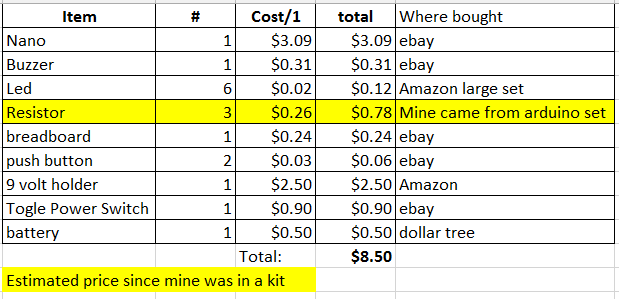
Shows Electrical connections using breadboardShows wiring connections without solderingFollow the wires!Shows cost of each item , total cost and where bought.




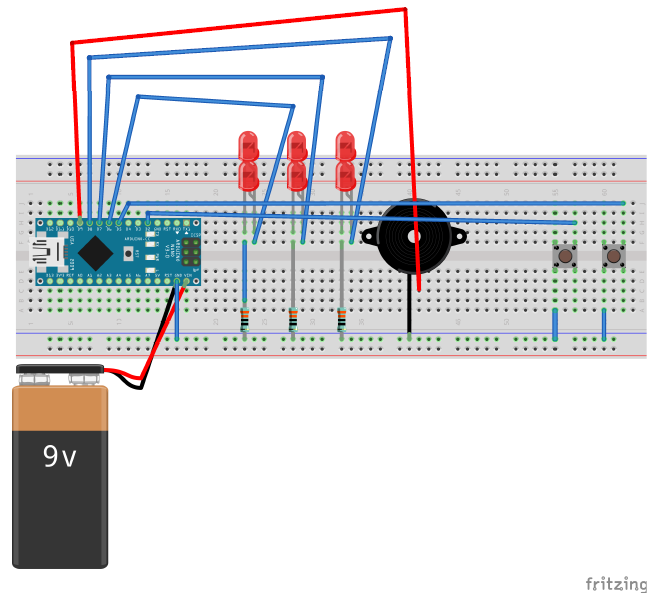 Shows wiring connections without soldering
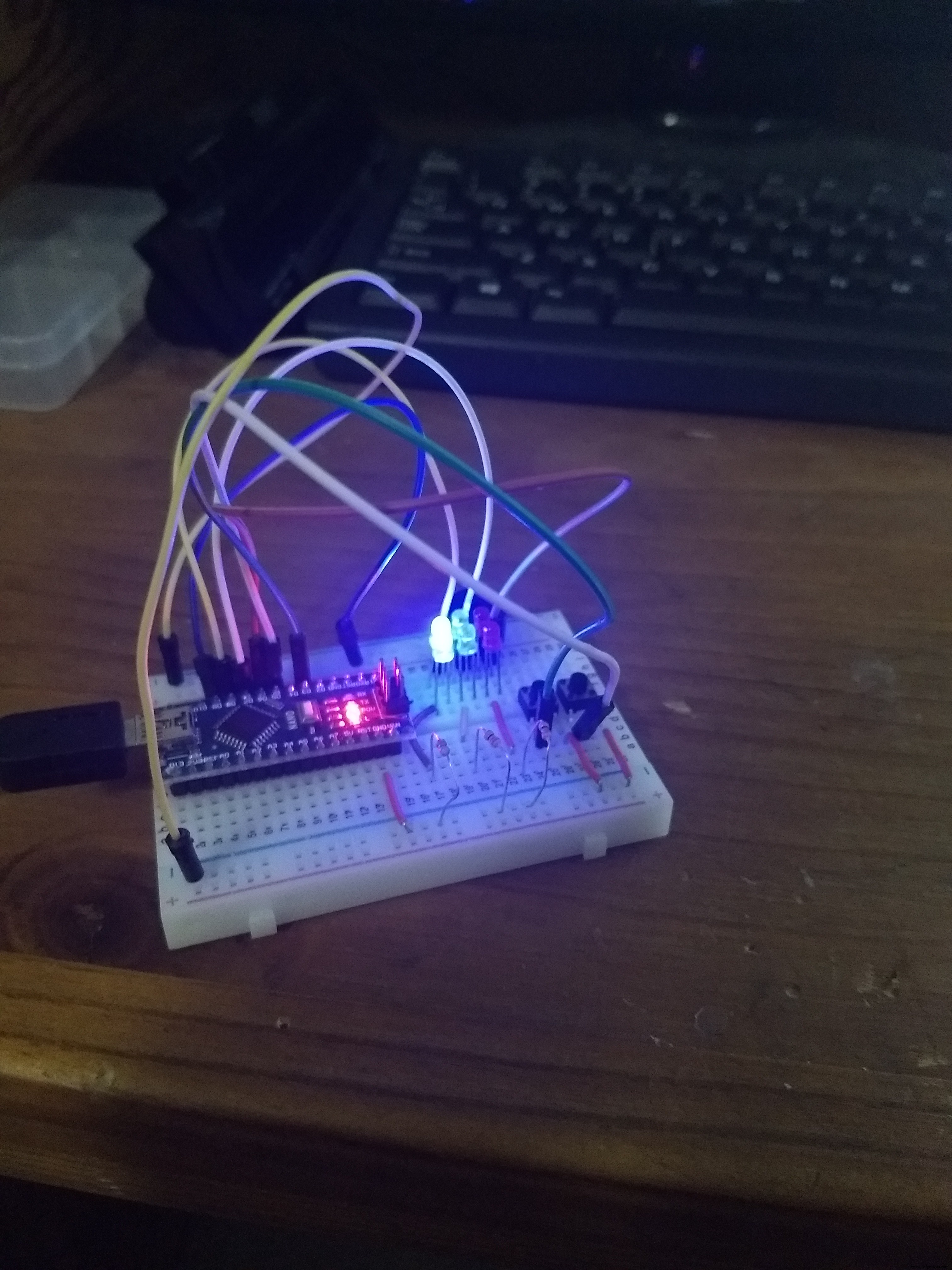 Follow the wires!
 Shows cost of each item , total cost and where bought.