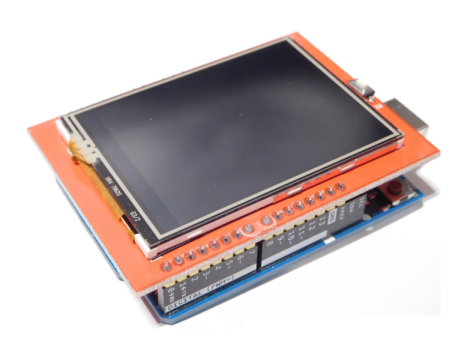
Menampilkan Gambar BMP dari Kartu SD pada Shield Arduino TFT LCD 2.4″
Komponen dan Perlengkapan
Komponen
Keterangan
Jumlah
Arduino UNO
×
1
Tentang Proyek Ini
Halo, tutorial ini adalah lanjutan dari 2 tutorial lain tentang Shield Arduino TFT LCD 2.4″, jadi yang pertama tentang Interfacing dan memperbaiki masalah fungsi sentuh serta sumbu terbalik, lalu yang kedua tentang menggunakan fungsi sederhana untuk menggambar berbagai bentuk dan cara membuat tombol sentuh untuk mengaktifkan beberapa fungsi…
Interfacing dan memperbaiki masalah sentuh pada Shield Arduino TFT LCD 2.4″
Tutorial Shield Layar Sentuh TFT LCD 2.4″
Namun hari ini kita akan membahas tentang membaca gambar dari kartu SD dan menampilkannya pada layar, pertama jangan lupa untuk mencolokkan kartu SD ke komputer Anda dan memformatnya sebagai FAT32 lalu transfer gambar Anda jangan lupa bahwa mereka harus dalam format “BMP”, Bitmaps 24 !! Untuk memiliki gambar yang benar resolusi harus 240*320, sedikit penjelasan:
Ini adalah orientasi normal layar Anda dapat menampilkan gambar 240*320, ini adalah rotasi default yang diatur setRotation(0);
Ini adalah orientasi layar jika Anda setRotation(1); dan sekarang Anda dapat menampilkan gambar 320*240.
Jadi Anda dapat memilih apa yang sesuai dengan Anda, baik mengubah rotasi layar atau rotasi gambar di PC Anda… lalu ingat atau salin nama gambar dan selesai, colokkan kartu SD Anda ke shield.
Ini adalah nama gambar bmp 24 bit saya pada kartu SD untuk seperti “Img1” kita memanggilnya dalam kode dengan menggunakan “Img1.bmp”.
Library:
Ini adalah library yang bekerja untuk saya: Unduh di sini jika Anda menggunakan library ini tetapi saat mencoba dengan kode contoh itu menunjukkan layar putih, Anda seharusnya mencari library yang sesuai dengan Anda.
Kode:
Berikut adalah kode yang saya gunakan dalam video dalam format .ino, jangan lupa untuk mengubah nama file yang Anda gunakan. Jangan lupa untuk memeriksa tutorial jika Anda membutuhkan bantuan.
Kode 1
Kode 2
Kode
TFT_Shield_SD_1.ino
TFT_Shield_SD_2.ino
TFT_Shield_SD_1.inoArduino
/*This code is to use with 2.4" TFT LCD touch screen shield, it reads bmp images stored on SD card *and shows them on the screen *Refer to SurtrTech.com for more details */ #include <SPFD5408_Adafruit_GFX.h> // Core graphics library #include <SPFD5408_Adafruit_TFTLCD.h> // Hardware-specific library #include <SPI.h> #include <SD.h> #define LCD_CS A3 // Chip Select goes to Analog 3 #define LCD_CD A2 // Command/Data goes to Analog 2 #define LCD_WR A1 // LCD Write goes to Analog 1 #define LCD_RD A0 // LCD Read goes to Analog 0 #define SD_CS 10 //SD card pin on your shield Adafruit_TFTLCD tft(LCD_CS, LCD_CD, LCD_WR, LCD_RD, A4); void setup() { Serial.begin(9600); tft.reset(); uint16_t identifier = tft.readID(); pinMode(10, OUTPUT); digitalWrite(10, HIGH); tft.begin(identifier); if (!SD.begin(SD_CS)) { progmemPrintln(PSTR("failed!")); return; } } void loop() { bmpDraw("Logo.bmp", 0, 0); //Calling the bmpDraw function ("Name_of_your_image.bmp",x,y) (x,y) is the starting position of the picture drawing delay(2000); bmpDraw("Img2.bmp", 0, 0); delay(2000); bmpDraw("Img3.bmp", 0, 0); delay(2000); } #define BUFFPIXEL 20 //Drawing speed, 20 is meant to be the best but you can use 60 altough it takes a lot of uno's RAM //Drawing function, reads the file from the SD card and do the //conversion and drawing, also it shows messages on the Serial monitor in case of a problem //No touchy to this function :D void bmpDraw(char *filename, int x, int y) { File bmpFile; int bmpWidth, bmpHeight; // W+H in pixels uint8_t bmpDepth; // Bit depth (currently must be 24) uint32_t bmpImageoffset; // Start of image data in file uint32_t rowSize; // Not always = bmpWidth; may have padding uint8_t sdbuffer[3*BUFFPIXEL]; // pixel in buffer (R+G+B per pixel) uint16_t lcdbuffer[BUFFPIXEL]; // pixel out buffer (16-bit per pixel) uint8_t buffidx = sizeof(sdbuffer); // Current position in sdbuffer boolean goodBmp = false; // Set to true on valid header parse boolean flip = true; // BMP is stored bottom-to-top int w, h, row, col; uint8_t r, g, b; uint32_t pos = 0, startTime = millis(); uint8_t lcdidx = 0; boolean first = true; if((x >= tft.width()) || (y >= tft.height())) return; Serial.println(); progmemPrint(PSTR("Loading image '")); Serial.print(filename); Serial.println('\''); // Open requested file on SD card if ((bmpFile = SD.open(filename)) == NULL) { progmemPrintln(PSTR("File not found")); return; } // Parse BMP header if(read16(bmpFile) == 0x4D42) { // BMP signature progmemPrint(PSTR("File size: ")); Serial.println(read32(bmpFile)); (void)read32(bmpFile); // Read & ignore creator bytes bmpImageoffset = read32(bmpFile); // Start of image data progmemPrint(PSTR("Image Offset: ")); Serial.println(bmpImageoffset, DEC); // Read DIB header progmemPrint(PSTR("Header size: ")); Serial.println(read32(bmpFile)); bmpWidth = read32(bmpFile); bmpHeight = read32(bmpFile); if(read16(bmpFile) == 1) { // # planes -- must be '1' bmpDepth = read16(bmpFile); // bits per pixel progmemPrint(PSTR("Bit Depth: ")); Serial.println(bmpDepth); if((bmpDepth == 24) && (read32(bmpFile) == 0)) { // 0 = uncompressed goodBmp = true; // Supported BMP format -- proceed! progmemPrint(PSTR("Image size: ")); Serial.print(bmpWidth); Serial.print('x'); Serial.println(bmpHeight); // BMP rows are padded (if needed) to 4-byte boundary rowSize = (bmpWidth * 3 + 3) & ~3; // If bmpHeight is negative, image is in top-down order. // This is not canon but has been observed in the wild. if(bmpHeight < 0) { bmpHeight = -bmpHeight; flip = false; } // Crop area to be loaded w = bmpWidth; h = bmpHeight; if((x+w-1) >= tft.width()) w = tft.width() - x; if((y+h-1) >= tft.height()) h = tft.height() - y; // Set TFT address window to clipped image bounds tft.setAddrWindow(x, y, x+w-1, y+h-1); for (row=0; row<h; row++) { // For each scanline... // Seek to start of scan line. It might seem labor- // intensive to be doing this on every line, but this // method covers a lot of gritty details like cropping // and scanline padding. Also, the seek only takes // place if the file position actually needs to change // (avoids a lot of cluster math in SD library). if(flip) // Bitmap is stored bottom-to-top order (normal BMP) pos = bmpImageoffset + (bmpHeight - 1 - row) * rowSize; else // Bitmap is stored top-to-bottom pos = bmpImageoffset + row * rowSize; if(bmpFile.position() != pos) { // Need seek? bmpFile.seek(pos); buffidx = sizeof(sdbuffer); // Force buffer reload } for (col=0; col<w; col++) { // For each column... // Time to read more pixel data? if (buffidx >= sizeof(sdbuffer)) { // Indeed // Push LCD buffer to the display first if(lcdidx > 0) { tft.pushColors(lcdbuffer, lcdidx, first); lcdidx = 0; first = false; } bmpFile.read(sdbuffer, sizeof(sdbuffer)); buffidx = 0; // Set index to beginning } // Convert pixel from BMP to TFT format b = sdbuffer[buffidx++]; g = sdbuffer[buffidx++]; r = sdbuffer[buffidx++]; lcdbuffer[lcdidx++] = tft.color565(r,g,b); } // end pixel } // end scanline // Write any remaining data to LCD if(lcdidx > 0) { tft.pushColors(lcdbuffer, lcdidx, first); } progmemPrint(PSTR("Loaded in ")); Serial.print(millis() - startTime); Serial.println(" ms"); } // end goodBmp } } bmpFile.close(); if(!goodBmp) progmemPrintln(PSTR("BMP format not recognized.")); } // These read 16- and 32-bit types from the SD card file. // BMP data is stored little-endian, Arduino is little-endian too. // May need to reverse subscript order if porting elsewhere. uint16_t read16(File f) { uint16_t result; ((uint8_t *)&result)[0] = f.read(); // LSB ((uint8_t *)&result)[1] = f.read(); // MSB return result; } uint32_t read32(File f) { uint32_t result; ((uint8_t *)&result)[0] = f.read(); // LSB ((uint8_t *)&result)[1] = f.read(); ((uint8_t *)&result)[2] = f.read(); ((uint8_t *)&result)[3] = f.read(); // MSB return result; } // Copy string from flash to serial port // Source string MUST be inside a PSTR() declaration! void progmemPrint(const char *str) { char c; while(c = pgm_read_byte(str++)) Serial.print(c); } // Same as above, with trailing newline void progmemPrintln(const char *str) { progmemPrint(str); Serial.println(); }
TFT_Shield_SD_2.inoArduino
/*This code is meant for the 2.4" TFT LCD touch screen shield with UNO board * It creates a little slide show of images that changes depending on where you pressed on the screen * The images are read from SD card * Refer to SurtrTech.com for more details */ #include <SPFD5408_Adafruit_GFX.h> // Core graphics library #include <SPFD5408_Adafruit_TFTLCD.h> // Hardware-specific library #include <SPI.h> #include <SD.h> #include <SPFD5408_TouchScreen.h> //Touch screen functions library #if defined(__SAM3X8E__) #undef __FlashStringHelper::F(string_literal) #define F(string_literal) string_literal #endif //The parameters bellow depends on your shield so make sure the pins are correct #define YP A3 // must be an analog pin, use "An" notation! #define XM A2 // must be an analog pin, use "An" notation! #define YM 9 // can be a digital pin #define XP 8 // can be a digital pin //Don't forget if your touch function doesn't work check the values above it may be (A1 A2 7 6) resp // Calibrate values you may want to run the calibration code first and set those points #define TS_MINX 176 #define TS_MINY 159 #define TS_MAXX 921 #define TS_MAXY 884 #define MINPRESSURE 10 #define MAXPRESSURE 1000 TouchScreen ts = TouchScreen(XP, YP, XM, YM, 300); #define LCD_CS A3 // Chip Select goes to Analog 3 #define LCD_CD A2 // Command/Data goes to Analog 2 #define LCD_WR A1 // LCD Write goes to Analog 1 #define LCD_RD A0 // LCD Read goes to Analog 0 #define SD_CS 10 // Set the chip select line to whatever you use Adafruit_TFTLCD tft(LCD_CS, LCD_CD, LCD_WR, LCD_RD, A4); char x[]="x1.bmp"; /*Here in this code I declared the names as an Array * So I can do modifications if I want to scroll through * Make sure you images have a number like "1" so you can increase it or decrease * to go to the next image */ void setup() { Serial.begin(9600); tft.reset(); uint16_t identifier = tft.readID(); pinMode(10, OUTPUT); digitalWrite(10, HIGH); tft.begin(identifier); if (!SD.begin(SD_CS)) { progmemPrintln(PSTR("failed!")); return; } tft.setRotation(1); //To do a 90 rotation of the screen bmpDraw(x, 0, 0); //we draw the first image which is x -> "x1.bmp" as we declared } void loop() { if(x[1]<49) //So we don't go to some strange values I add here a reset of the values x[1]=49; //If we're already in the first picture we stay there, same for the last if(x[1]>52) //"1" in char is "49" and "4" is "52" I wrote them in this format so I can manipulate them x[1]=52; TSPoint p = ts.getPoint(); //checking if the user touched the screen pinMode(XM, OUTPUT); pinMode(YP, OUTPUT); if (p.z > MINPRESSURE && p.z < MAXPRESSURE) { //p.z means the pressure value so if the touch wants to be detected // it pressure should be in this range (it's enough) p.x = map(p.x, TS_MINX, TS_MAXX, 0, tft.width()); //x and y positions of the touch so the program know the postion where the user has pressed p.y = map(p.y, TS_MINY, TS_MAXY, 0, tft.height());; //The screen is rotated like in setRotation(1) so now I'm playing on Y axis only //And here I got like two big rectangles on the sides of the screen that are considered as buttons //You can add conditions on x to make small buttons if(p.y > 0 && p.y < 100 ){ Serial.println("Left"); //I did this to show on serial monitor that I pressed left x[1]=x[1]-1; //here we change the name of the file we want to read x[]="x1.bmp" and x[1] is the 1 in the name and x[0] is x bmpDraw(x, 0, 0); //So what I do is just increase it to make it 2 or decrease it to make it 0 (refer to the first "if" to see the solution for this case as 0 doesn't exist) delay(300); //Then I draw the image which now has a different name depending on which side I pressed } //Adding a little delay so the touch detection wont bounce else if(p.y >200 && p.y <320){ Serial.println("Right"); x[1]=x[1]+1; bmpDraw(x, 0, 0); delay(300); } } #define BUFFPIXEL 20 //Printing speed 20 is meant to be the best, you can go to 60 but using too much RAM //drawing function no touchy :D void bmpDraw(char *filename, int x, int y) { File bmpFile; int bmpWidth, bmpHeight; // W+H in pixels uint8_t bmpDepth; // Bit depth (currently must be 24) uint32_t bmpImageoffset; // Start of image data in file uint32_t rowSize; // Not always = bmpWidth; may have padding uint8_t sdbuffer[3*BUFFPIXEL]; // pixel in buffer (R+G+B per pixel) uint16_t lcdbuffer[BUFFPIXEL]; // pixel out buffer (16-bit per pixel) uint8_t buffidx = sizeof(sdbuffer); // Current position in sdbuffer boolean goodBmp = false; // Set to true on valid header parse boolean flip = true; // BMP is stored bottom-to-top int w, h, row, col; uint8_t r, g, b; uint32_t pos = 0, startTime = millis(); uint8_t lcdidx = 0; boolean first = true; if((x >= tft.width()) || (y >= tft.height())) return; Serial.println(); progmemPrint(PSTR("Loading image '")); Serial.print(filename); Serial.println('\''); // Open requested file on SD card if ((bmpFile = SD.open(filename)) == NULL) { progmemPrintln(PSTR("File not found")); return; } // Parse BMP header if(read16(bmpFile) == 0x4D42) { // BMP signature progmemPrint(PSTR("File size: ")); Serial.println(read32(bmpFile)); (void)read32(bmpFile); // Read & ignore creator bytes bmpImageoffset = read32(bmpFile); // Start of image data progmemPrint(PSTR("Image Offset: ")); Serial.println(bmpImageoffset, DEC); // Read DIB header progmemPrint(PSTR("Header size: ")); Serial.println(read32(bmpFile)); bmpWidth = read32(bmpFile); bmpHeight = read32(bmpFile); if(read16(bmpFile) == 1) { // # planes -- must be '1' bmpDepth = read16(bmpFile); // bits per pixel progmemPrint(PSTR("Bit Depth: ")); Serial.println(bmpDepth); if((bmpDepth == 24) && (read32(bmpFile) == 0)) { // 0 = uncompressed goodBmp = true; // Supported BMP format -- proceed! progmemPrint(PSTR("Image size: ")); Serial.print(bmpWidth); Serial.print('x'); Serial.println(bmpHeight); // BMP rows are padded (if needed) to 4-byte boundary rowSize = (bmpWidth * 3 + 3) & ~3; // If bmpHeight is negative, image is in top-down order. // This is not canon but has been observed in the wild. if(bmpHeight < 0) { bmpHeight = -bmpHeight; flip = false; } // Crop area to be loaded w = bmpWidth; h = bmpHeight; if((x+w-1) >= tft.width()) w = tft.width() - x; if((y+h-1) >= tft.height()) h = tft.height() - y; // Set TFT address window to clipped image bounds tft.setAddrWindow(x, y, x+w-1, y+h-1); for (row=0; row<h; row++) { // For each scanline... // Seek to start of scan line. It might seem labor- // intensive to be doing this on every line, but this // method covers a lot of gritty details like cropping // and scanline padding. Also, the seek only takes // place if the file position actually needs to change // (avoids a lot of cluster math in SD library). if(flip) // Bitmap is stored bottom-to-top order (normal BMP) pos = bmpImageoffset + (bmpHeight - 1 - row) * rowSize; else // Bitmap is stored top-to-bottom pos = bmpImageoffset + row * rowSize; if(bmpFile.position() != pos) { // Need seek? bmpFile.seek(pos); buffidx = sizeof(sdbuffer); // Force buffer reload } for (col=0; col<w; col++) { // For each column... // Time to read more pixel data? if (buffidx >= sizeof(sdbuffer)) { // Indeed // Push LCD buffer to the display first if(lcdidx > 0) { tft.pushColors(lcdbuffer, lcdidx, first); lcdidx = 0; first = false; } bmpFile.read(sdbuffer, sizeof(sdbuffer)); buffidx = 0; // Set index to beginning } // Convert pixel from BMP to TFT format b = sdbuffer[buffidx++]; g = sdbuffer[buffidx++]; r = sdbuffer[buffidx++]; lcdbuffer[lcdidx++] = tft.color565(r,g,b); } // end pixel } // end scanline // Write any remaining data to LCD if(lcdidx > 0) { tft.pushColors(lcdbuffer, lcdidx, first); } progmemPrint(PSTR("Loaded in ")); Serial.print(millis() - startTime); Serial.println(" ms"); } // end goodBmp } } bmpFile.close(); if(!goodBmp) progmemPrintln(PSTR("BMP format not recognized.")); } // These read 16- and 32-bit types from the SD card file. // BMP data is stored little-endian, Arduino is little-endian too. // May need to reverse subscript order if porting elsewhere. uint16_t read16(File f) { uint16_t result; ((uint8_t *)&result)[0] = f.read(); // LSB ((uint8_t *)&result)[1] = f.read(); // MSB return result; } uint32_t read32(File f) { uint32_t result; ((uint8_t *)&result)[0] = f.read(); // LSB ((uint8_t *)&result)[1] = f.read(); ((uint8_t *)&result)[2] = f.read(); ((uint8_t *)&result)[3] = f.read(); // MSB return result; } // Copy string from flash to serial port // Source string MUST be inside a PSTR() declaration! void progmemPrint(const char *str) { char c; while(c = pgm_read_byte(str++)) Serial.print(c); } // Same as above, with trailing newline void progmemPrintln(const char *str) { progmemPrint(str); Serial.println(); }