Lilin Cetak Investasi: Jenis, Manfaat, dan Panduan Pemilihan
Manufacturers use range of techniques to create complex parts and components. One of oldest methods still used today is investment casting. This process involves creating item out of wax and then building ceramic shell around it. Once shell is complete, wax is melted out (called dewaxing) before molten metal is poured into ceramic shell. Once metal solidifies, ceramic shell is removed as part is now created.
There are numerous waxes that can be selected. Type of wax used will be based on several factors including flow properties, whether wax will be reclaimed and recycled, dimensional consistency, surface finish and requirements of application. Several waxes you will often hear about are filled pattern wax, non-filled pattern wax, runner wax, water-soluble wax and sticky wax.
Filled Pattern Waxes
Filled pattern waxes are type of investment casting wax that has fillers added. These fillers can provide certain properties to casting to ensure strength, dimensional stability, lower thermal expansion and minimal shrinkage. Types of fillers found in filled pattern waxes will vary based on supplier, yet some common fillers may include bisphenol-A (BPA), organic fillers, terephthalic acid, and cross-linked polystyrene.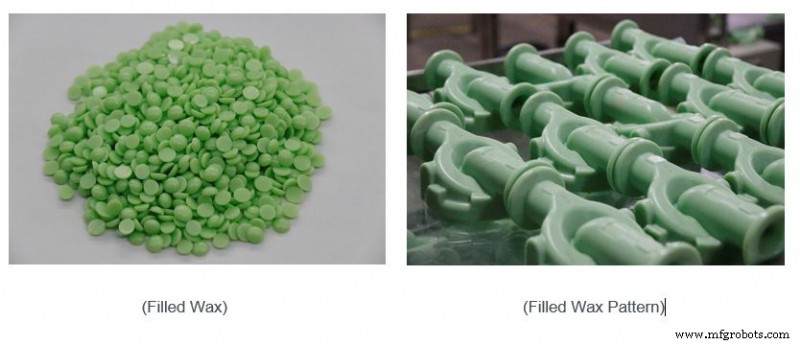
Both small and large wax pattern productions can use filled pattern waxes. Two major advantages to these waxes are that they have low thermal expansion and minimal shrinkage. They don’t require wax chills to be placed into cavity of patterns to prevent shrinkage as wax solidifies.
This wax is often used when looking for more dimensional control of created part or component and when using wide range of injection temperatures. Due to filler added, some wax may remain in ceramic shell after dewaxing process as it takes longer for wax to be burnt out. Filler pattern waxes can be difficult to reclaim and recycle depending on density of filler material.
Non-filled Pattern Waxes
Non-filled, or unfilled, pattern wax blends contain less filler materials. This type of wax offers consistent mechanical performance and thermal performance. They are typically used for small and medium wax patterns when there are complex geometries and very defined patterns. Non-filled waxes have exceptional flow properties.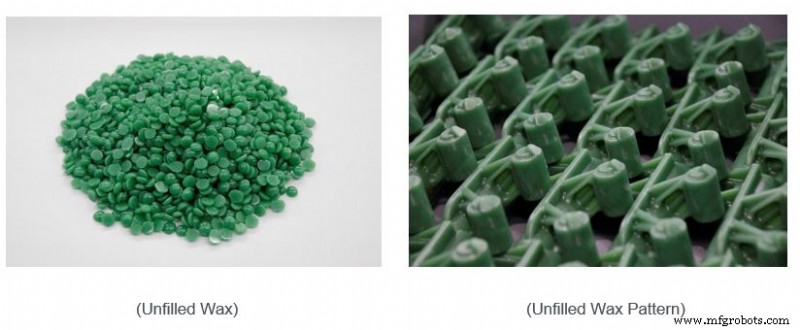
Main advantage to non-filled waxes is that they provide high surface quality. So ceramic mold will have fewer cracks and defects. It also completely dewaxes from ceramic shell as it can be reclaimed and recycled.
Care must be taken when using non-filled waxes in investment casting processes. Due to slower solidification, surface of pattern can sink. There may also be unwanted shrinkage along cross sections of pattern depending on wax temperature. Depending on part configuration, use of wax chills may be necessary with non-filled pattern waxes to avoid material shrinkage.
Runner Waxes
Runner wax blends are used by investment casting companies when desiring exceptional mechanical strength and lower viscosity. This type of wax has lower melting point than pattern waxes. So it will drain completely out of ceramic mold during dewaxing process without need to use higher temperatures.
Advantages to runner wax is that it has good soldering strength and minimum thermal expansion. Workers can handle wax without worrying about part breaking in ceramic mold. Wax pattern will need to be immersed in water and stored there until it completely solidifies.
Water-Soluble Waxes
Some parts and components will require complex and intricate internal designs. So wax pattern must have intricate cores placed inside. To create these cores, water-soluble wax is used. Once core is completed, it is placed into wax pattern die and then pattern wax is injected into die. When wax pattern is cooled, water-soluble cores are dissolved inside by placing pattern into water and acid bath.
Sticky Waxes
Sticky waxes are commonly used during mounting and finishing processes. These waxes help bond different pattern waxes together or when constructing sprue assembly. Wax helps to create strong adhesion with parts so they will stand up to being handled by workers when creating ceramic shell.
Impro’s Investment Casting Services
At Impro, we offer investment casting for wide range of applications including automotive, medical, aerospace, and industrial equipment. When looking for economical manufacturing process that is trusted, reliable and repeatable, investment casting can provide superior results. Contact us today for more information.



