Menguasai Analisis Data Lantai Pabrik: Alat untuk Pabrik Mengaktifkan IoT
Alat pengumpulan dan analisis data lantai pabrik baru dapat meredakan beban dari digitalisasi operasi pabrik di era IoT
Seiring gerak menuju industri manufaktur yang lebih terhubung semakin mendapatkan momentum dan produsen mulai mengumpulkan data lantai pabrik, kebutuhan akan analisis data yang cepat dan efisien menjadi semakin krusial. Alat pengumpulan dan analisis data sangat penting dalam era manufaktur digital/Industri 4.0, dan produsen sedang menyiapkan solusi baru untuk membantu mereka mengumpulkan, mengelola dan menganalisis data lantai pabrik dengan lebih efektif, memanfaatkan indikator kinerja utama (KPI) seperti overall equipment effectiveness (OEE), uptime mesin, utilisasi mesin/spindel dan metrik lainnya.
Banyak opsi pengumpulan data manufaktur dan pemantauan mesin tersedia, sebagian besar menawarkan setidaknya beberapa analitik metrik manufaktur dasar dalam paket pemantauan lantai pabrik atau sistem eksekusi manufaktur (MES) systems. Dalam beberapa kasus, perusahaan otomasi bekerjasama dengan penyedia IT terkemuka, seperti kemitraan terbaru yang diumumkan oleh penyedia otomasi ABB Inc. (Cary, NC, dan Zurich) dan Hewlett Packard Enterprise Co. (HPE; Palo Alto, CA) yang akan menggabungkan keahlian otomasi industri dan teknologi operasional (OT) ABB dengan pengalaman IT hibrida dan portofolio perangkat lunak HPE.
Bekerjasama OT dengan IT
Dalam kemitraan ABB/HPE, yang diumumkan pada November 2017, penawaran digital Ability ABB akan digabungkan dengan solusi IT hibrida HPE. Solusi Ability akan berjalan pada platform hibrida seperti HPE ProLiant for Microsoft Azure Stack, dengan penerapan di lokasi yang dipilih pelanggan di pabrik industri dan datacenter, atau di cloud publik Microsoft, sesuai kebutuhan untuk memenuhi persyaratan performa, keamanan atau kolaborasi lintas situs.
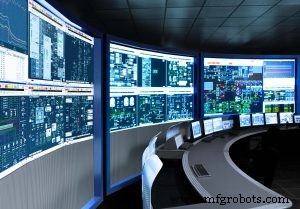
Kemitraan memindahkan sumber daya komputasi lebih dekat ke tempat yang dibutuhkan, menggunakan “edge computing.” ABB dan HP akan mengintegrasikan otomatisasi datacenter Ability, yang mengontrol dan memantau infrastruktur, dengan OneView, perangkat lunak otomatisasi infrastruktur IT HPE. “Sekadar jujur, kami tidak bisa melakukan ini sendiri; kami butuh mitra untuk hibrida ini, dan OT/IT diperlukan,” said Dublin-based Ciaran Flanagan, group vice president dan head of global datacenter solutions untuk ABB. Dengan menggabungkan IT dan OT, yang sebagian besar masih terisolasi saat ini, “kami pikir ada peluang besar, dan ini berkembang dengan cepat,” he added.
Menawarkan pengguna datacenter edge yang aman untuk lingkungan industri jarak jauh, kemitraan ABB/HPE juga menggunakan infrastruktur rak Rittal dengan sistem distribusi daya industri ABB dan perangkat lunak serta layanan infrastruktur yang ditentukan perangkat lunak HPE. “Lapisan protokol sangat berbeda dalam OT daripada dalam IT,” observed Volkhard Bregulla, HPE vice president, global manufacturing industries. “Sisi IT cukup maju.” Solusi ABB-HPE akan tersedia pada setengah pertama 2018.
Mengumpulkan, Kemudian Menganalisis Data Bengkel
Di lantai pabrik, banyak opsi yang tersedia untuk memantau dan mengumpulkan data, sebagian besar menawarkan setidaknya analitik mesin dasar dan beberapa analisis lanjutan lantai pabrik.
Saat memantau mesin, manajer bengkel pertama perlu tahu kapan mesin tertentu sedang berjalan, atau apakah mesin mati atau offline. Penting untuk tahu kapan mesin berada di bawah kontrol program, according to David McPhail, president dan CEO, Memex Inc. (Burlington, ON). “Kami netral dengan itu ketika datang ke cara Anda terhubung,” he said.
Dengan platform MERLIN (Manufacturing Execution Real-Time Lean Information Network) Tempus Memex, produsen proses dan diskrit dapat menghubungkan mesin mereka di lingkungan on-premises atau cloud. MERLIN Tempus adalah perangkat lunak MES yang menampilkan dasbor dan dapat terhubung menggunakan FANUC FOCAS, MTConnect, OPC dan protokol lain untuk menghubungkan alat mesin melalui Internet.
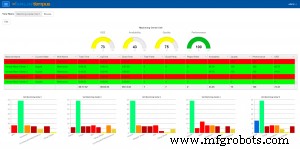
Untuk peralatan legacy yang tidak cerdas, Memex mengembangkan antarmuka MTConnect. “Ada 16 sinyal input digital dari mesin,” said McPhail. “Ada tiga aliran data: dari peralatan; dari modal manusia, sesuatu yang berada di bawah kontrol manusia [dan] yang tidak dapat dikatakan oleh mesin; dan dari solusi eksternal seperti ERP.”
Pengguna dapat menjalankan Tempus MES, yang merupakan Manufacturing Operations Management (MOM) portfolio, di lantai pabrik untuk memeriksa status mesin, McPhail said. “Typically our people will run our software on a tablet and walk about the shop floor. Let’s say an operator is having trouble with a part; you’ll get a message, ‘Support the Internal Customer.’ That turns the operator from a reactive to an active mode.
“There’s no custom programming,” McPhail continued, dan sistem ini mencakup alat analitis. “The data collection piece is foundational. The business case we’ve chosen is OEE, but you could insert TPM [Total Predictive Maintenance] and many others. It essentially calculates the financial impact of poor performance.”
Memex sedang mengembangkan modul FOEE (Financial OEE) untuk dirilis lebih akhir tahun ini yang akan menghitung untuk bengkel biaya menjalankan peralatan di bawah pengaturan yang tidak optimal. Modul akan menunjukkan kepada manajer bengkel “right now you’re running at less than top performance, by a delta of this much, and every hour that you run [at that level] costs you that much,” McPhail said.
Monitoring a Must, but Avoid Analysis Paralysis
Pertanyaan besar untuk bengkel yang mengatur pemantauan/analisis data adalah seberapa banyak data yang harus dikumpulkan. Sementara industri menyorot kebutuhan untuk “Big Data” analysis, untuk bengkel rata-rata less may be more.
“We work with our customers to understand the equation. The how is a known entity. The why, the business case that underpins it,” is what Memex works on, McPhail said.
Sementara beberapa perusahaan bekerja pada masalah Big Data yang melibatkan lingkungan simulasi, seperti CAE data, di sebagian besar bengkel that is not the case. “Big Data, we call that digital exhaust,” McPhail added. “If you take a Mazak machine, if you subscribe to every tag, that [amount of data] will overwhelm you. Do you really need to know every data point?”
Pengembang lain, Predator Software (Portland, OR), aims its Predator suite of shop-floor monitoring applications at everything from two-man shops to large manufacturing organizations, according to Mike Rogers, Predator Software director, automation and OEM relations. “Predator MDC [machine data collection] is our core product for monitoring, and with over 20 different protocols, from Mori, OPC and OPC/UA, we can monitor anything on the shop floor,” Rogers said.
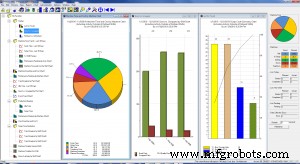
Pengumpulan dan analisis data semakin diterima oleh bengkel saat ini. “It’s going to become the hottest topic,” Rogers said. “Everyone wants it and not everyone has it. … Large corporations want Big Data. The little guy [needs to] learn to walk before they run. You’re going to get overwhelmed otherwise.”
A key is convincing customers to focus on simple things, he noted, such as “will the machine cycle? Is it sitting? Is it running? … It can be an overwhelming process,” Rogers said. “One of the problems I run into is finding the champion in the organization that will follow it through.”
Predator’s MDC solution features an intuitive interface, making it simple for users to get started, Rogers said. “MDC has [a built-in] charting and reporting engine. If you run the permutations, we have somewhere between 20,000–30,000 reports.” MDC is one of Predator’s eight core products aimed at shop-floor data collection and monitoring, control and communication. The products all work off one database, and when customers buy MDC, they get the DNC communications module as well. Predator’s software supports Microsoft’s Access database, used by many smaller shops, Rogers said, and it also supports Microsoft SQL Express, SQL Server, and Oracle databases. The Predator software can operate either on premises or on the cloud.
Follow the OEE
Bengkel baik kecil maupun besar perlu memperhatikan metrik OEE, which can allow machine operators and managers to optimize efficiency. Visualizing the process, making it easy for shop personnel to quickly see, understand and react to changing conditions, is critical.
“We offer both the data collection and the data analysis sides, and we can either provide that a la carte or as a full solution,” said Jeff Price, executive vice president dan general manager, 5ME LLC (Cincinnati). With 5ME’s Freedom suite, users get software plus available hardware to link and control a variety of machines.
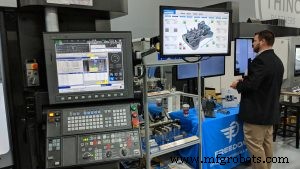
“Our team has a long history with OT-type devices, and we have interfaces or adapters to almost any asset in the plant, often on the CNC controller,” Price added. “When we have legacy controllers, we also have a hardware appliance” to connect to the network. Along with Freedom eLog software, 5ME offers data visualization with customizable smartboards displayed on flat-screen TVs, Price said.
“With the smartboard technology, we have dashlets or wizards—a collection of data with pie charts and bar charts—that you can save into smartboards,” he said. The smartboards use Raspberry Pi embedded systems to help boost processing speed where the data is most needed. “We’re using Raspberry Pi with smartboards for driving visualization to the shop floor,” Price said. “For years in automotive plants we had Andon boards, but those are pretty rigid.”
Freedom servers, located on the cloud or on premise, are where the data crunching happens. With the connectivity offered, customers can build on gains the industry has already made, Price said, such as lean manufacturing and six sigma. “We short-circuit that whole process,” he added. “Most of our customers will see a minimum 20% productivity improvement with OEE, which is comprised of availability, performance, and quality. Availability is are you running [at optimal levels], performance is are you producing at the levels you should be, and quality is purely a yield-type situation.”
With the OEE metric alone, shops can make big performance gains, he said. “Availability is where the big gains are. The initial improvements are 10–20% in 30 days.” The Freedom suite is a software install, over the web. “It’s a light IT footprint, harnessing the power of the processing on controllers. We can do 100 machines in four weeks.”
Price added that shops must winnow the data down to what’s most important. “It depends on the analysis tools; we call it drip—data-rich, information-poor,” he said. “If your systems present the right metrics, there’s a ton of improvements to be gained.”
Taking that First Data Step
Not all shops, particularly smaller ones without big OT/IT budgets, are easily convinced of factory data monitoring’s value. “People are trying to understand their baseline,” Price said. “The things like how often is your equipment running? There’s still a gap—our role is to bridge that gap. They don’t understand it.” 5ME customers like Textron, Bell Helicopter, Caterpillar, Schlumberger, and Cummins, are interested in Big Data, but they don’t all have a use case for it, said Price, although he sees one such use in predictive maintenance.
“Data collection and analysis is essential to any modern manufacturer—from small shops to corporate enterprises,” said Jody Romanowski, CEO of Cimco Americas Inc. (Streamwood, IL). “Accurate real-time data helps identify areas that can be improved, whether they are equipment, processes or personnel. That data is required to reach significant improvements.” Cimco’s shop-floor offering, MDC-Max, is a data-collection solution providing structured and automated production monitoring. The scalable MDC-Max can benefit both small shops and large manufacturers, Romanowski said.
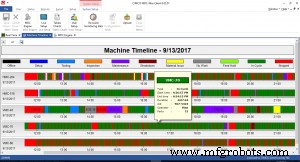
“As customers consider real-time data analysis, they are often a bit overwhelmed by a whole range of data points. Our approach is to keep the project simple initially, analyzing three to five data points to secure early success,” she said. “Manufacturers can then start analyzing further data points gradually. In an OEE context, all manufacturers struggle with a complete and consistent analysis of the quality parameter.
“We don’t recommend a Big Data approach to collecting machine data,” Romanowski continued. “We advise keeping it simple and reaping the low-hanging fruit initially, then building upon experiences and the challenges overcome. When companies operating shop floors all over the world strive to get a consistent overview globally, including across business units, the project complexity will increase dramatically, though not necessarily from a Big Data perspective. Instead, complexity normally grows from handling legacy machines/systems and different procedures and/or cultures. That puts further emphasis on keeping first phases as operational and simple as possible, while keeping focus on tactical goals such as ERP integration in further stages of the project.”
For shops that collect the data but don’t adequately analyze it, new analysis tools may offer an edge. “Often, their current software is too limited, rigid or complicated,” Romanowski said. “MDC-Max is flexible enough to scale and meet the future needs of our customers. The data must be easily accessible on any device and it must be aggregated in a meaningful way—such as in reports and real-time dashboards.”
At a Cimco customer outside Tianjin, China, Romanowski said the manufacturer had a key machine that was a productivity bottleneck, affecting other machines. “Upon putting a simple MDC-Max system in operation with a limited number of data points, the manufacturer experienced a 30% higher utilization rate on that specific machine,” she noted, “thereby increasing productivity both from reducing that specific bottleneck and by increasing productivity on all other machines as well. The estimated payback time for the investment, in this case, was less than four months.”



