Abrasive Jet Machining: Komponen, Mekanisme, dan Penggunaan Praktis
In this article you will learn about Abrasive Jet Machining, including working principle, parts, working, applications, advantages and disadvantages.
Abrasive Jet Machining
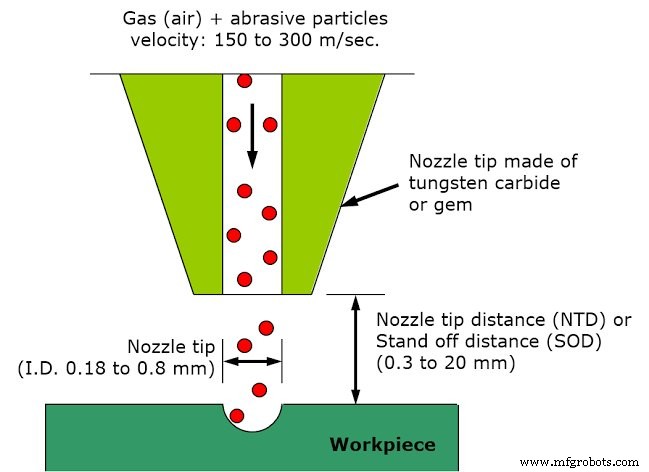
Abrasive Jet Machining is a non traditional method of removing materials by using focused stream of abrasive grains of Al2O3 or SiC carried by high-pressure gas or air at high velocity is made to impinge on work surface through nozzle of 0.3- to 0.5-mm diameter.
In other words, Abrasive jet machining is process of impinging high-speed stream of abrasive particles onto work surface via nozzle with high-pressure gas or air, and metal removal occurs due to erosion caused by high-speed abrasive particles.
Impact of particles generates concentrated force sufficient to perform operations such as cutting; material is removed by erosion of work material with abrasive grits at speed of 150-300m/s. Abrasive grits are applied in high-velocity gas stream.
Working Principle of Abrasive Jet Machining
Working principle of abrasive jet machining is use of high-speed stream of abrasive particles carried by high-pressure gas or air on work surface via nozzle.
Metal is removed due to erosion caused by abrasive particles impacting work surface at high speeds. With each impact, small bits of material are loosened, exposing new surface to jet.
This process is mainly employed for such machining works which are otherwise difficult, such as thin sections of hard metals and alloys, cutting of material which is sensitive of heat damage, producing intricate holes, deburring, etching, polishing etc.
Abrasive Jet Machining Parts
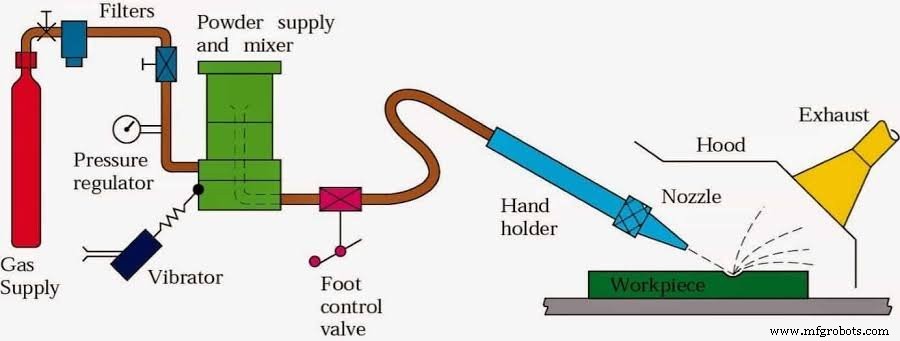
1. Gas Supply
In machining system, a gas (nitrogen, CO2, or air) is supplied under pressure of 2 to 8 kg/cm2. Oxygen should never be used because it causes violent chemical reaction with workpiece chips or abrasives. This abrasive and gas mixture is ejected at high velocity of 150 to 300 m/min from small nozzle mounted on fixture.
2. Filter
Filter cleans fuel supply so that dirt and other impurities do not impede process’s progress.
3. Pressure Gauge
Pressure gauge is used to control compressed air pressure used in abrasive jet machining. as pressure determines depth of cut and amount of force required to cut
4. Mixing Chamber
Abrasive powder is fed into mixing chamber, and amount of abrasives can be controlled using vibrator. So that abrasives and gases are thoroughly mixed in mixing chamber.
5. Nozzle
Nozzle is used to increase velocity of fine abrasive jet slurry at expense of pressure, because we know lowering pressure causes velocity to increase. Jet’s velocity will be between 100 and 300 meters per second.
Nozzle can be adjusted to achieve desired angular cutting and material can be removed by impact erosion.
Because of high wear, nozzle is usually made of tungsten carbide. Nozzle’s diameter is approximately 0.2-0.8mm.
Nozzle’s material should be corrosion resistant. Nozzle has circular or rectangular cross-section, and head can be straight or at right angle.
6. Abrasives
In abrasive jet machining, silicon carbide and aluminum oxide glass beads are used as abrasives. Abrasives’ shapes can be regular or irregular. Abrasives range in size from 10 to 50 microns. Mass flow rate of abrasives is between 2 and 20 grams per minute.
Choice of abrasives is determined by MRR, type of work material, and level of machining accuracy required.
Aluminum oxide (Al2O3) size 12, 20, 50 microns is good for cleaning, cutting, and deburring; Dolomite size 200 mesh is used for Etching and polishing.
Sodium bicarbonate has particle size of 27 microns and is used for cleaning, deburring, and cutting soft materials.
7. Workpiece
Metal removal rate is determined by nozzle diameter, composition of abrasive gas mixture, hardness of abrasive particles and hardness of work material, particle size, jet velocity, and distance of workpiece from jet. In cutting glass, typical material removal rate for abrasive jet machining is 16 mm/min.
8. Regulator
Regulator is used for controlling flow of compressed air flowing through pipe.
Working of Abrasive Jet Machining
In machining system shown in Fig, a gas (nitrogen, CO2, or air) is supplied under pressure of 2 to 8 kg/cm2. Oxygen should never be used because it causes violent chemical reaction with workpiece chips or abrasives. After filtration and regulation, gas is passed through mixing chamber that contains abrasive particles and vibrates at 50 Hz.
From mixing chamber, gas, along with entrained abrasive particles (10–40 µm), passes through 0.45 mm diameter tungsten carbide nozzle at speed of 150 to 300 m/s. Aluminum oxide (Al2O3) and silicon carbide powders are used for heavy cleaning, cutting, and deburring.
Magnesium carbonate is recommended for use in light cleaning and etching, while sodium bicarbonate is used for fine cleaning and cutting of soft materials. Commercial-grade powders are not suitable because their sizes are not well classified. They may contain silica dust, which can be health hazard.
It is not practical to reuse abrasive powder because contaminations and worn grit will cause decline of machining rate. Abrasive powder feed rate is controlled by amplitude of vibrations in mixing chamber. Nozzle standoff distance is 0.81 mm. Relative motion between workpiece and nozzle is manually or automatically controlled using cam drives, pantographs, tracer mechanisms, or using computer control according to cut geometry required.
Masks of copper, glass, or rubber may be used to concentrate jet stream of abrasive particles to confined location on workpiece. Intricate and precise shapes can be produced by using masks with corresponding contours. Dust removal equipment is incorporated to protect environment.
Applications of Abrasive Jet Machining
Lets discuss what is use of abrasive jet machining:
Drilling holes, cutting slots, cleaning hard surfaces, deburring, and polishing
Deburring of cross holes, slots, and threads in small precision parts that require burr-free finish, such as hydraulic valves, aircraft fuel systems, and medical appliances.
Machining intricate shapes or holes in sensitive, brittle, thin, or difficult-to-machine materials
Insulation stripping and wire cleaning without affecting conductor
Micro-deburring of hypodermic needles
Frosting glass and trimming of circuit boards, hybrid circuit resistors, capacitors, silicon, and gallium.
Removal of films and delicate cleaning of irregular surfaces because abrasive stream is able to follow contours
It is used for abrading and frosting glass, ceramics, and refractories and is less expensive than etching or grinding.
Cleaning of metal layering, such as resistive coating.
Small casting deflashing and parting line trimming on injection molded parts and forgings
It is used to engrave registration numbers on toughened glass used in automobile windows.
Used to clean metallic molds and cavities.
Cleaning surfaces of corrosion, paints, glues, and other contaminants.
Advantages and Disadvantages of Abrasive Jet Machining
Advantages
Because AJM is cool machining process, it is best suited for machining brittle and heat-sensitive materials like glass, quartz, sapphire, and ceramics.
Process is used for machining super alloys and refractory materials.
It is not reactive with any workpiece material.
No tool changes are required.
Intricate parts of sharp corners can be machined.
Machined materials do not experience hardening.
No initial hole is required for starting operation as required by wire EDM.
Material utilization is high.
It can machine thin materials.
A high surface finish can be obtained through this process.
Disadvantages
Removal rate is slow.
Stray cutting can’t be avoided (low accuracy of ±0.1 mm).
Tapering effect may occur especially when drilling in metals.
Abrasive may get impeded in work surface.
Suitable dust-collecting systems should be provided.
Soft materials can’t be machined by process.
Silica dust may be health hazard.
Ordinary shop air should be filtered to remove moisture and oil.
Process capacity is less due to low material removal rate.
While machining soft materials, abrasive becomes embedded, reducing surface finish.
Tapering of hole caused by unavoidable variation of abrasive jet disturbs cutting accuracy.
Because of stray cutting, accuracy is poor.
Because dust collection system is basic requirement for preventing atmospheric pollution and health hazards, additional cost will be present.
Nozzle’s life is limited (300 hours).
Because sharp edges of abrasive powders wear down and smaller particles can clog nozzle, they cannot be reused.
Short standoff distance can cause nozzle damage.
Because flaring effect of abrasive jet, process accuracy is poor.
A taper will be present in deep holes.
AJM process is harmful to environment and causes pollution.
Abrasive particles in air can create hazardous environment.
Effect of Grain Size And Flow Rate of Abrasives on Material Removal Rate
At given pressure, MRR increases with increasing abrasive flow rate and is determined by abrasive particle size.
However, after reaching optimum value, MRR decreases as abrasive flow rate is increased further.
This is because mass flow rate of gas decreases as abrasive flow rate increases, thus mixing ratio increases, resulting in decrease in material removal rate due to decrease in available energy for erosion.
Effect of Exit Gas Velocity And Abrasive Particle Density
Velocity of carrier gas that transports abrasive particles varies significantly with density of abrasive particles.
When internal gas pressure is near twice pressure at exit of nozzle and abrasive particle density is zero, exit velocity of gas can be increased to critical velocity.
Exit velocity will decrease for same pressure condition if density of abrasive particles is gradually increased.
It is because kinetic energy of gas is used to move abrasive particles.
Effect of Mixing Ratio on Material Removal Rate
As abrasive’s mass flow rate increases, its velocity decreases, reducing available energy for erosion and, ultimately, material removal rate.
Effects of Nozzle Pressure on MRR
Abrasive flow rate can be increased by increasing carrier gas flow rate. As internal gas pressure rises, so does abrasive mass flow rate, and thus MRR.
Rate of material removal increases as gas pressure rises. Kinetic energy of abrasive particles is responsible for material removal during erosion process.
Why are abrasive particles not reused in Abrasive jet machining?
Fine abrasive particles entrained in gas stream are permitted to impact work surface at high velocity (100–300m/s) to gradually degrade material in abrasive jet machining (AJM) process. Impact erosion is mechanism for material removal. Carrier gas transports eroded material in form of solid small particles and utilized abrasive grits away from machining zone. Because of following two reasons, reusing these abrasive particles is not suggested.
Wear debris contaminates abrasives (removed work material).
Abrasives lose their sharp edges, reducing cutting effectiveness.
Frequently Asked Questions
What is use of abrasive jet machining?
Common applications include cutting heat-sensitive, brittle, thin, or hard materials. It is specifically used to cut intricate shapes or form specific edge shapes.
Which gas is used in abrasive jet machining?
Abrasive jet machining creates jet by mixing gas with abrasive particles. Gas used is known as carrier gas. Air, carbon dioxide, and nitrogen are three of most commonly used carrier gases. Oxygen is never used as carrier gas because it can oxidize work piece’s surface.
AJM can be used for
Abrasive jet Machining process can be used for deburring, cutting, cleaning and for many other heavy duty applications.
In abrasive jet machining process abrasive particles should be
In AJM, generally, abrasive particles of around 50 μm grit size would impinge on work material at velocity of 200 m/s from nozzle of I.D. of 0.5 mm with stand-off distance of around 2 mm.
How is material removed in Abrasive jet machining?
In abrasive jet machining, focused stream of abrasive particles is impinged on work surface through nozzle and work material is removed by erosion by high velocity abrasive particles carried by high pressure air or gas. Because carrier gas acts as coolant, cutting process is cool. High-velocity abrasive stream is created by transferring pressure energy of carrier gas or air to its kinetic energy, resulting in high-velocity jet.
Abrasive Jet Machining MCQ
Q. In Abrasive jet machining, work piece material of removed by which of following means? a) Vaporization b) Electro plating c) Mechanical abrasion d) Corrosion Answer: c
Explanation: Abrasive particles hit surface with high pressure and high velocities, which removes material.
Q.Metal removal rate in Abrasive jet machining increases with
a) Increase in standoff distance but decreases beyond certain limit b) Decrease in abrasive flow rate c) Decrease in grain size in grain size of abrasives d) None of mentioned Answer: a Explanation: MRR is directly proportional to standoff distance up to certain limit. After certain limit, kinetic energy of abrasives starts decreasing.
Q. Which type of materials can be machined using Abrasive jet machining? a) Glass b) Ceramics c) Hard materials d) All of mentioned
Answer: d Explanation: Materials like ceramics, glass, hard and super hard materials can be machined using Abrasive jet machining.
Hope you liked this article covering all aspects of Abrasive Jet Machining covering working principle, advantages, disadvantages and application.
If you liked article, please share it with friends and give feedback in comment section.