Cupola Furnace Dijelaskan: Desain, Operasi, Manfaat & Aplikasi di Pabrik Pengecoran
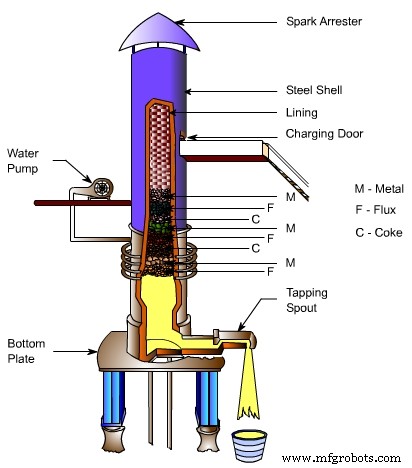
Cupola Furnace is a melting device used to melt cast iron, Ni-resist iron, and some bronzes and It is used in Foundries. The cupola can be made of any size and size of cupola is measured in diameters which range from 1.5 to 13 feet. Shape of cupola is cylindrical And equipment is arranged in vertical fitted with doors which swings down and Out to drop bottom.
The top is open or fitted with a cap to escapes gases or rain entering. The cupola may be fitted with a cap to control emission of gases and to Pull the gases into the device to cool the gases and remove all the Particulate Matter.
The cupola shell is made of steel and has a refractory brick and plastic refractory Patching material lining. The clay and sand mixture is used as a bottom line and lining is temporary. The coal can be mixed with clay lining so when it heats up coal decomposes and bond becomes friable. This makes opening up of two holes easy. Bottom of cupola lining is compressed against bottom doors. Cooling jackets are also fitted with some cupola’s to keep sides cool and with oxygen injection to make coke fire burn hotter.
Cupola Furnace:
Principal:
Cupola furnace works on simple principal that combustion of coke generates carbon dioxide and heat and this causes iron to melt. Iron drains downward when get melted.
Afterwards, carbon dioxide is reduced partly, reduced again by consuming energy and coke with carbon monoxide, carbon dioxide and supplied coke is present in reaction equilibrium so it is possible to show defined combustion ratio for utilization of thermal energy for coke combustion.
Finally, high concentration of carbon monoxide is present in exhaust gas and it can be extracted from furnace.
Construction:
Cupola furnace constructed in form of hollow cylindrical vertical steel shell and it is lined from inside with refractory material. This furnace is generally supported on four cast iron lags mounted on concrete base.
 |
| Image Source |
Bottom of furnace is closed by two cast iron doors hinged to bed plate of furnace. A wind box cast iron encircles to outside of furnace bottom.This box is connected to furnace blower pipe known as blast pipe. Air which supplies oxygen necessary to burn fuels forced through cupola by blower.Top of furnace is shielded by mesh screen and topped with cone-shaped spark arrester, which permits free vent of waste gas and deflects spark dan dust back into furnace.
Working
Basically, operation of cupola furnace consists of following steps:
After building cupola make sure it is dried completely before getting it to fire. Any slag around tuyeres from previous runs needs to be cleaned properly.
Also, A broken part is repaired with mixture of silica sand and fire clay. Over Brunt area, layer of refractory material is applied To about thickness 6 inches or more is rammed on bottom sloping toward tap hole to ensure better flow of molten metal.
A hole opening of about 30 mm diameter and tap hole of about 25 mm diameter is being provided there.
a fire of wood is ignited. When wood burns well coke is dumped on bed well from top. Make sure coke gets burned too. A bed of coke about 40 inches is placed next to sand.
Firstly The air blast is turned on At lower blowing rate than as normal for provoking coke. A measuring rod is also used which indicates height of coke bed. For about 3 hours firing is done before molten metal required.
Now charge is fed into cupola. Many factors like charge composition, affect final structure of gray cast iron obtained. It composed of 10% steel, 50% grey cast iron scrap, and 3% limestone as flux.
Alternate layers are formed by these constituents. Besides limestone, fluorspar dan soda ash are also used as flux material. Main function of flux is to remove impurities in iron and protect iron from oxidation.
after fully charged furnace, it is allowed to remain as such for about 1 hour. As this process goes in charge slowly gets heated up as air blast is kept shut this time and because of this, iron gets soaked up.
At end of soaking period, air blast is opened. Topmost opening is kept closed till metal melts. Sufficient amount of metal is collected. Contents of charge move downwards as melting proceeds.
Rate of charging is equal to rate of melting. Furnace is kept full throughout heat.
Closing feeding of charge and air blast is stopped when no more melting is required. Bottom plate swings to open when prop is removed. Deposited slag is being removed.Cupola runs continuously and melting period does not exceed 4 hours most of time. But can be operated for more than 10 hours.
Advantages:
- Low cost of construction.
- Low cost of maintenance.
- Low cost of operation.
- Very skilled operators are not required.
- Simple in construction
- Simple in operations.
- Melting composition can be controlled.
- Small floor area is required.
Disadvantages:
With long list of advantages, cupola furnace also comes with few limitations or disadvantages listed below:
- It is sometimes difficult to maintain temperature in cupola furnace.
- Metal elements are converted to their oxides which are not suitable for casting.
Application:
Cupola furnace is used widely as melting unit for cast iron. Some characteristic that makes cupola furnace a primary method used in melting irons in foundries. Some of them are:
- Cupola furnace is only method which is continuous while operations.
- Melting rate of cupola furnace is high.
- It is easy to operate.Operating costs in use of cupola furnace is comparability very low to other methods for this purpose.
Although having such great factors, use of cupola furnace is declining and people are opting for electric induction melting.
This is all about cupola furnace. Jika ada pertanyaan mengenai artikel ini, tanyakan melalui komentar. Jika suka artikel ini, jangan lupa untuk membagikannya dengan teman-teman di jaringan sosial. Langganan situs web kami untuk artikel informatif lainnya. Terima kasih telah membaca.



