Pengelasan Plasma Arc (PAW): Proses, Bagian, dan Cara Kerja
Apa Itu Plasma Arc Welding?
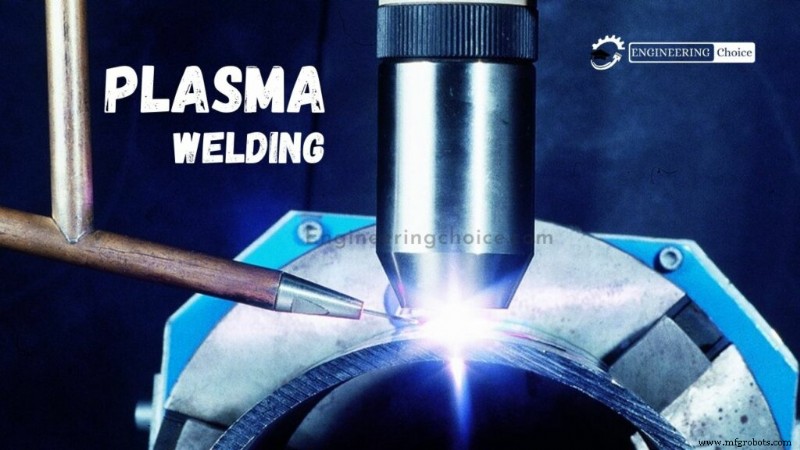
Plasma arc welding (PAW) adalah proses pengelasan arc yang sangat mirip dengan TIG welding di mana arc dibuat di antara elektroda tungsten yang runcing dan workpiece. Namun, dengan memposisikan elektroda di dalam tubuh torch, plasma arc dapat dipisahkan dari envelop shielding gas. Plasma kemudian dipaksa melalui nozzle tembaga yang dibor halus yang menyempitkan arc.
Plasma welding adalah proses di mana plasma arc dihidupkan di antara elektroda dan material dasar dan digunakan untuk pengelasan. Ia diklasifikasikan sebagai jenis elektroda non-konsumtif dan, seperti TIG welding, menggunakan batang tungsten sebagai elektroda. Perbedaannya adalah ia menggunakan nozzle untuk menutupi elektroda dan plasma gas untuk mencegah arc menyebar.
Konsentrasi panas yang tinggi yang dihasilkan memungkinkan pengelasan dengan kecepatan tinggi dengan lebar sempit dan distorsi yang lebih sedikit. Karena arc yang sangat arah, plasma welding cocok untuk fillet welds dan dapat menghilangkan spatter.
Konsumsi elektroda yang rendah memungkinkan pengelasan berkualitas tinggi selama waktu yang lama. Meskipun pelatih lebih mahal dibandingkan TIG welders, biaya operasional rendah. Ini adalah salah satu metode terbaik untuk pengelasan otomatis.
Pilot gas (inert gas) mengalir melalui torch dan diionisasi (plasma conversion) oleh panas pilot arc. Ionized pilot gas membentuk plasma jet, keluar dari lubang nozzle dan bertindak sebagai konduktor untuk arc current.
Ini menyempitkan arc untuk memberikan energy density yang tinggi dan melesat keluar dari lubang ujung insert. Arc spread terbatas pada sekitar seperempat dari TIG welding, resulting in a higher current density arc.
Bore Diameter
Tiga mode operasi dapat dihasilkan dengan mengubah bore diameter dan plasma gas flow rate:
Micro plasma: 0.1 to 15A
The microplasma arc can be operated at very low welding currents. The columnar arc is stable even when arc length is varied up to 20mm.
Medium current: 15 to 200A
At higher currents, from 15 to 200A, the process characteristics of the plasma arc are similar to the TIG arc, but because the plasma is constricted, the arc is stiffer. Although the plasma gas flow rate can be increased to improve weld pool penetration, there is a risk of air and shielding gas entrainment through excessive turbulence in the gas shield.
Keyhole plasma: over 100A4
By increasing welding current and plasma gas flow, a very powerful plasma beam is created which can achieve full penetration in a material, as in laser or electron beam welding.
During welding, the hole progressively cuts through the metal with the molten weld pool flowing behind to form the weld bead under surface tension forces. This process can be used to weld thicker material (up to 10mm of stainless steel) in a single pass.
Construction of the Plasma Arc Welding Machine:
The Plasma Arc Welding setup consists of the following components:
- Power Supply
- Plasma Welding Torch
- Water re-circulator
- Tungsten Electrode
- Shielding Gas
- Plasma Gas
- Torch Accessory Kit (Tips, ceramics, collets, electrodes set-up gages)
- Filler Material
Let me give you a brief overview of each component.
1. Power Supply:
The plasma arc welding process needed a high-power DC supply to generate the electric spark in between the tungsten electrode and welding plates
This welding can weld at a low 2 amp and the maximum current which it can handle is about 300 amp. It needs about 80 volts for proper working.
The power source consists of a transformer, rectifier, and control console.
2. Plasma Welding Torch:
This is the most important part of the plasma welding process.
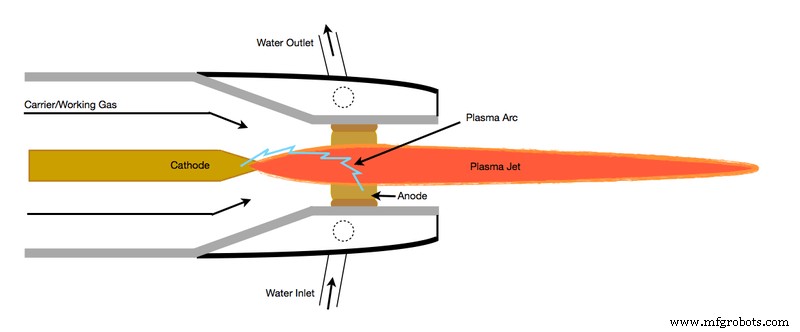
This torch is quite similar to used in TIG welding.
PAW torches are water-cooled because the arc is contained inside the torch which produces high heat, so a water jacket is provided outside the torch.
3. Water Re-circulator:
This mechanism is used to cool the welding torch by the continuous flow of water outside of the welding torch.
4. Tungsten Electrode:
In this machine, we use a no-consumable tungsten electrode. As we know tungsten can withstand very high temperatures.
5. Shielding Gas:
In this welding process, we use two inert gases. We need to maintain a low pressure to avoid turbulence while welding due to this low-pressure gas welding shield is formed weekly, that’s why we need to charge another inert gas through the outer portion of the welding force in a high flow rate, to make the weld shield sustainable.
The inert gases which are used in this process can be helium, argon, and also hydrogen as per the need, and it totally depends on the temperature.
6. Plasma Gas:
It is an ionized hot gas composed of nearly the same numbers of electrons and ions. It has sufficient energy to free electrons from molecules, atoms, and electrons to synchronize.
It is the main energy source of this welding.
7. Torch Accessory Kit:
These kits are used to expanding the performance of the welding torch.
8. Filler Material:
In Plasma welding there is no filler material is used. If the filler material is used, then it is directly fed into the weld zone.
How does Plasma Welding Works?
A plasma is a gas that is heated to an extremely high temperature and ionized so that it becomes electrically conductive. Similar to GTAW (Tig), the plasma arc welding process uses this plasma to transfer an electric arc to a workpiece. The metal to be welded is melted by the intense heat of the arc and fuses together.
In the plasma welding torch, a Tungsten electrode is located within a copper nozzle having a small opening at the tip. A pilot arc is initiated between the torch electrode and nozzle tip. This arc is then transferred to the metal to be welded.
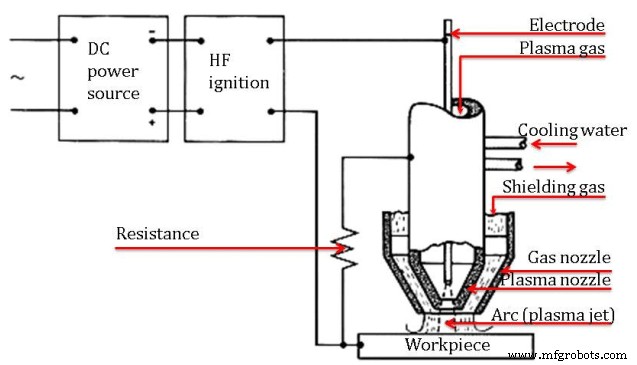
By forcing the plasma gas and arc through a constricted orifice, the torch delivers a high concentration of heat to a small area. With high-performance welding equipment, the plasma process produces exceptionally high-quality welds.
Plasma gases are normally argon. The torch also uses a secondary gas, argon, argon/hydrogen, or helium which assists in shielding the molten weld puddle thus minimizing oxidation of the weld.
Keuntungan Plasma Arc Welding
Keuntungan Plasma Arc Welding adalah sebagai berikut:
- Torch design allows better control of the arc.
- This method provides more freedom to observe and control the weld.
- The higher the heat concentration and plasma jet allow faster travel speeds.
- The high temperature and high heat concentration of plasma allow the keyhole effect.
- This provides complete penetration with the single-pass welding of many joints.
- The heat-affected zone is smaller compared to GTAW (Gas tungsten arc welding).
- It uses less current input as compared to another welding process.
Kekurangan Plasma Arc Welding:
Kekurangan Plasma Arc welding adalah:
- It produces wider welds and heat-affected zones compare to LBW and EBW.
- Plasma welding equipment is very costly. Hence it will have a higher startup cost.
- It requires training and specialization to perform plasma welding.
- It produces ultraviolet and infrared radiation.
- The method produces higher noise on the order of about 100dB.
- The torch is bulky and hence manual welding is a bit difficult and requires training as mentioned.
Aplikasi Plasma Arc Welding:
Aplikasi Plasma Arc welding adalah:
- This welding is used in the marine and aerospace industries.
- This is used to weld pipes and tubes of stainless steel or titanium.
- It is mostly used in electronic industries.
- Also, this is used to repair tools, die, and mold.
- This is used for welding or coating on a turbine blade.
So, this is all about Plasma Arc Welding Machining, I hope you enjoyed this article. I also wrote articles on some other welding processes to check out those too. And moreover, do not forget to share the article on your favorite social platform.
Plasma welding Video



