Manufaktur Aditif di Seluruh Dunia: Kematangan dan Pertumbuhan Cepat Cetak 3D di Asia-Pasifik
Periksa Part 1 dari seri AM Around the World, yang mengeksplorasi adopsi pencetakan 3D di Amerika Utara dan Eropa.
Asia-Pasifik (APAC) sedang bertransformasi menjadi pasar pencetakan 3D yang tumbuh paling cepat. Wilayah ini diperkirakan akan tumbuh dengan tingkat tertinggi 18% dan akan mengeluarkan $3,6 miliar pada pencetakan 3D dalam 5 tahun ke depan.
Sampai akhir-akhir ini, wilayah ini tertinggal dalam adopsi pencetakan 3D, dibandingkan Amerika Utara dan Eropa. Namun, minat yang tumbuh dari perusahaan manufaktur APAC dan perkenalan banyak strategi dan kebijakan yang dipimpin pemerintah telah membantu beberapa negara dalam wilayah ini untuk sukses menciptakan ekosistem AM yang berkelanjutan.
Di bawah ini, kita melihat bagaimana pencetakan 3D diadopsi dan didukung di China, Korea Selatan, Singapura, dan Australia.
Pencetakan 3D di ‘pabrik dunia’
Spotlight: China
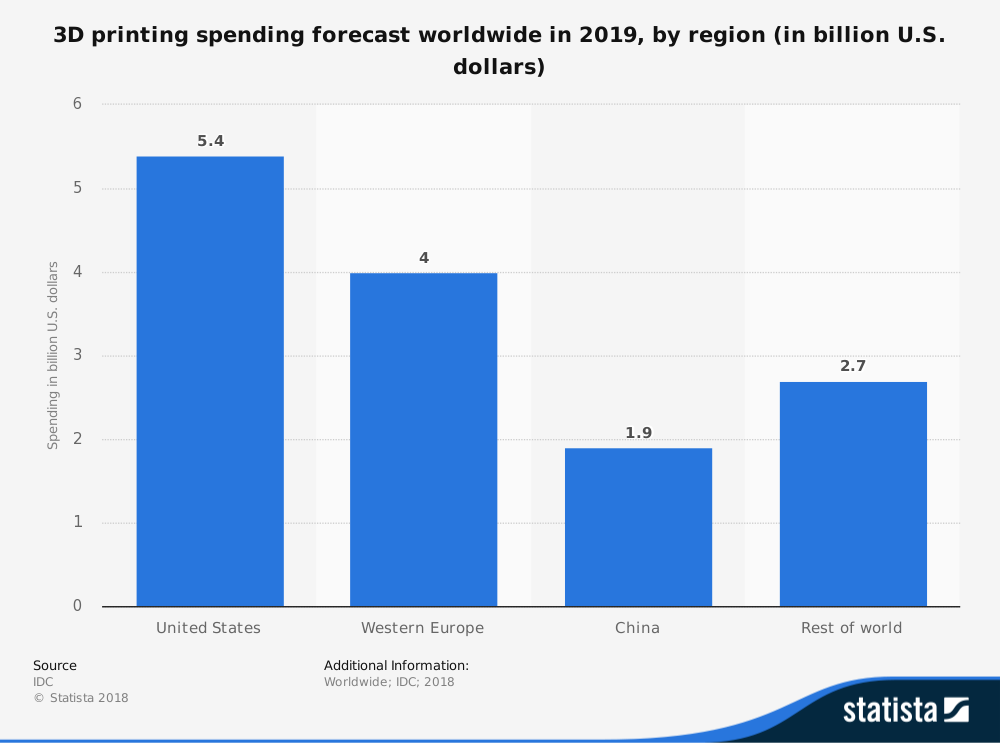
China mungkin adalah kekuatan terbesar di balik pertumbuhan pencetakan 3D di Asia, mengingat dukungan pemerintah yang besar untuk mempromosikan industri. Pasar pencetakan 3D China diperkirakan bernilai $1,8 miliar pada 2018. Saat ini, ini adalah pasar pencetakan 3D terbesar ketiga, setelah AS dan Eropa Barat.
Pada 2017, pemerintah China menerbitkan ‘Additive Manufacturing Industry Development Action Plan’, yang bertujuan untuk membuat industri AM nasional bernilai $3 miliar pada 2020.
Action Plan, yang merupakan bagian dari peta jalan strategis ‘Made in China 2025’ untuk sektor manufaktur negara, mencakup ambisi jangka panjang dan tujuan pengembangan untuk menjadikan China salah satu negara pencetakan 3D terkemuka. Salah satu highlight dari rencana adalah tujuan untuk memperkenalkan lebih dari 100 proyek pilot AM di seluruh 10 industri kunci, termasuk sektor medis, budaya, pendidikan, dan Internet.
Untuk mencapai tujuan ini, China memelihara perusahaan AM yang menjanjikan, mendukung standardisasi untuk industri AM China, dan berinvestasi dalam pengembangan tenaga kerja pencetakan 3D. Misalnya, China baru-baru ini mendirikan Perguruan Tinggi Pencetakan 3D pertama di dunia, Baiyun-Winbo 3D Printing Technology College di Guangzhou.
Negara juga berencana untuk memasang printer 3D di 400.000 sekolah dasar. Inisiatif seperti ini akan memberikan manfaat jangka panjang bagi masyarakat China, karena orang akan dididik dan terlatih dalam teknologi 3D dari usia muda.
Teknologi AM di China
Diperkirakan 48% pendapatan pencetakan 3D saat ini di China berasal dari printer 3D, (dibandingkan 37% untuk Eropa atau 33% untuk Amerika Serikat). Angka ini menunjukkan bahwa ada permintaan yang kuat untuk hardware pencetakan 3D di negara ini.
Salah satu area kunci yang melihat pertumbuhan cepat di China adalah pencetakan logam 3D, dengan Bright Laser Technologies dan Shining 3D yang mengembangkan printer 3D berbasis laser logam. Shining 3D, misalnya, baru-baru ini memperluas garis produk AM-nya dengan peluncuran printer 3D EP-M150. Printer SLM 3D baru ini cocok untuk aplikasi pencetakan logam 3D kecil, satu contohnya adalah mahkota gigi. Printer ini dikatakan mampu memproduksi 500 mahkota dengan hanya 1 kg serbuk logam.
Kenaikan mesin AM China sangat terlihat di TCT Asia 2018, salah satu pameran perdagangan terkait AM terbesar di China. TCT Magazine melaporkan bahwa ada sebanyak 38 printer logam 3D dari semua bentuk dan ukuran, yang dikembangkan dan diproduksi oleh perusahaan China.
Menurut pembicara TCT Asia dan ahli industri, Graham Tromans, ‘di China, AM logam dianggap lebih sebagai proses manufaktur dibandingkan proses plastik. Sektor otomotif dan penerbangan adalah yang terpenting bagi ekonomi manufaktur China dan itulah sebabnya banyak perusahaan yang mengembangkan mesin logam.’
Ada juga pilihan yang luas dari printer 3D polimer dari perusahaan seperti UnionTech (salah satu produsen printer SLA terbesar di China), INTAMSYS, dan Farsoon Technologies.
Industri yang Mengadopsi Pencetakan 3D
Menurut laporan EY terbaru, 78% perusahaan China yang disurvei telah mengadopsi pencetakan 3D pada 2019.
Tingkat adopsi yang tinggi ini dapat dijelaskan oleh permintaan yang tumbuh untuk produksi yang lebih cerdas dan efisien di China. Pencetakan 3D adalah salah satu teknologi yang diimplementasikan perusahaan untuk memenuhi kebutuhan ini.
Satu contohnya adalah sektor otomotif China. Pix Moving, start-up otomotif di Provinsi Guizhou, sedang mengembangkan mobil otonom dengan menggabungkan teknik pencetakan 3D dan desain generatif.
Secara khusus, perusahaan menggunakan teknologi Wire Arc Additive Manufacturing (WAAM) untuk mencetak 3D chassis mobil yang akan memiliki lebih sedikit bagian dan, oleh karena itu, akan jauh lebih ringan. Sukses dalam membuat mobil yang aman dan viable akan menjadikan Pix pionir di dunia.
Sektor China lain yang sedang direvolusi oleh pencetakan 3D adalah konstruksi. Perusahaan WinSun saat ini memimpin pencetakan 3D konstruksi di China. Printer 3D WinSun, yang berukuran 10 meter lebar dan 6,6 meter tinggi, menggunakan bahan khusus terbuat dari semen, pasir, dan serat, dicampur dengan aditif miliknya. Teknologi digunakan selama tahap prefabrikasi untuk mencetak dinding di pabrik, untuk kemudian dirangkaikan di lokasi.
WinSun pertama kali membuat sensation pada 2014, dengan sekelompok 10 rumah yang dicetak dari bahan konstruksi daur ulang dan dirangkaikan di Suzhou. Saat ini, perusahaan sedang mengerjakan pencetakan 3D kompleks gedung terbesar di dunia, yang diperkirakan akan diperkenalkan di Shanghai pada akhir tahun ini.
Saat datang ke industri kesehatan China, rumah sakit besar sudah mendapat manfaat dari model organ cetak 3D, yang digunakan oleh ahli bedah untuk mempersiapkan bedah kompleks.
Selain itu, beberapa rumah sakit di China telah mencetak 3D implan dalam praktik klinis selama bertahun-tahun. Misalnya, ahli bedah di Rumah Sakit Universitas Shandong Kedua mencetak 3D implan rahang bawah untuk seorang pasien muda pada 2018.
Selain itu, Rumah Sakit Tiga Universitas Peking, Rumah Sakit Militer Udara Tangdu, Rumah Sakit Ortopedik Provinsi Guangdong, dan rumah sakit tingkat lebih rendah lainnya, juga telah menerapkan implan ortopedik cetak 3D dalam pengobatan penyakit ortopedik kompleks.
Dengan tingkat adopsi yang tinggi dan keterlibatan pemerintah yang meningkat, pencetakan 3D memasuki periode emas di China. Dipujui sebagai pemimpin pencetakan 3D di masa depan, China berposisi baik untuk meraih gelar ini di masa dekat.
Spotlight: Korea Selatan
Korea Selatan juga memiliki fokus yang kuat pada pertumbuhan pencetakan 3D. Meskipun adopsi teknologi ini relatif lambat, dibandingkan negara maju lain, perusahaan Korea sekarang menargetkan untuk mengejar bidang ini di sektor yang berkembang pesat ini.
Untuk tetap mengikuti inovasi pencetakan 3D, pemerintah Korea menyediakan dukungan nasional. Pada 2014, mereka menetapkan peta jalan R&D pencetakan 3D. Rencana ini bertujuan untuk mendukung industri yang ada dengan ekosistem terintegrasi yang memungkinkan pemain untuk dengan mudah menggunakan dan terhubung dengan teknologi pencetakan 3D. Pemerintah pusat dan daerah telah mendirikan 8 pusat regional pencetakan 3D di seluruh negara untuk menyediakan infrastruktur dan layanan konsultasi pencetakan 3D.
Kesehatan Memimpin Adopsi AM
Largely due to strong government support, the medical sector has taken a leading role in adopting and implementing 3D printing in Korea.
Among the government’s 10 priority sectors, outlined in the 3D printing roadmap, healthcare accounts for the highest proportion. Furthermore, the government’s pilot projects to ‘foster new demands’ are mainly intended for the healthcare industry. This implies that from the government’s standpoint, healthcare 3D printing applications offer the quickest wins at the initial stage.
Thanks to the government’s support, there were 19 3D-printed medical devices, mostly orthopaedic implants, officially registered by the Ministry of Food and Drug Safety, by the end of 2016.
Could South Korea be the next global 3D printing leader?
Compared to other countries, South Korea was never caught up in the consumer 3D printing hype. Since the introduction of the technology in the country, Koreans have largely viewed it as an industrial process, not a consumer toy.
According to a report by EY, the familiarity with 3D printing in Korea grew from 24% in 2016 to 81% in 2019, making it the nation with the most 3D printing experience.
Furthermore, Korea accounted for roughly 4.1% of all installed AM systems in the world in 2018 and has the third-largest number of machines in the Asia-Pacific region.
Most of the 3D printing hardware in the country is imported. In 2017, overseas manufacturers accounted for more than 80% of total 3D printer sales in Korea, according to a report by Ipsos Business Consulting.
According to A.T Kearney, Korea could become the global leader, thanks to a national government-led R&D roadmap focused on 3D printing.
In addition to establishing the national AM strategy, Korea’s government invests heavily in AM technology development. In 2017, the 3D printing industry in Korea received 41.2 billion won (the equivalent of $37 million) in government funding. In 2019, the funding was increased to 59.3 billion won (the equivalent of $52.7 million).
Progressively, Korea is integrating AM into its economy for the benefit of manufacturers and its overall national production. We expect that Korea will be a significant growth market for AM technologies and applications through 2019 and in the years to come.
3D printing in the ASEAN region
The Association of Southeast Asian Nations (ASEAN) refers to a region in South East Asia that includes 10 countries: Myanmar, Laos, Vietnam, Cambodia, Thailand, Malaysia, Singapore, Brunei, Indonesia and the Philippines.
ASEAN’s 10 member countries have varying degrees of AM adoption, with many of them focused on developing the infrastructure and skills to benefit from this disruptive technology.
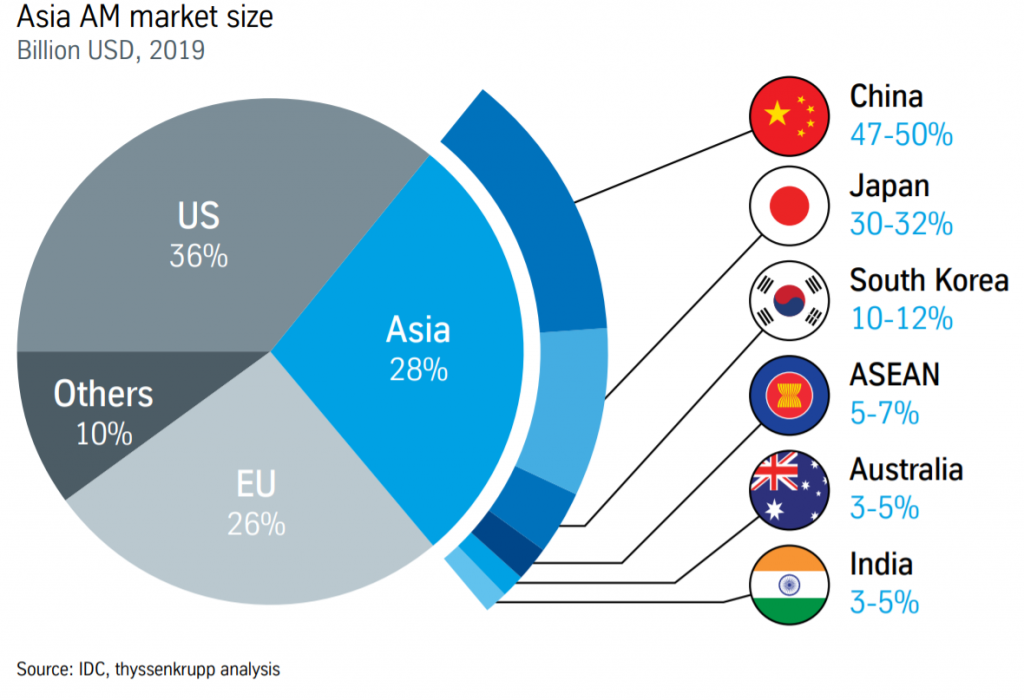
According to a white paper by ThyssenKrupp, one of the largest industrial groups in Germany, AM penetration in ASEAN today is small, representing only 5 to 7% of Asia’s total AM spend estimated at $3.8 billion for 2019.
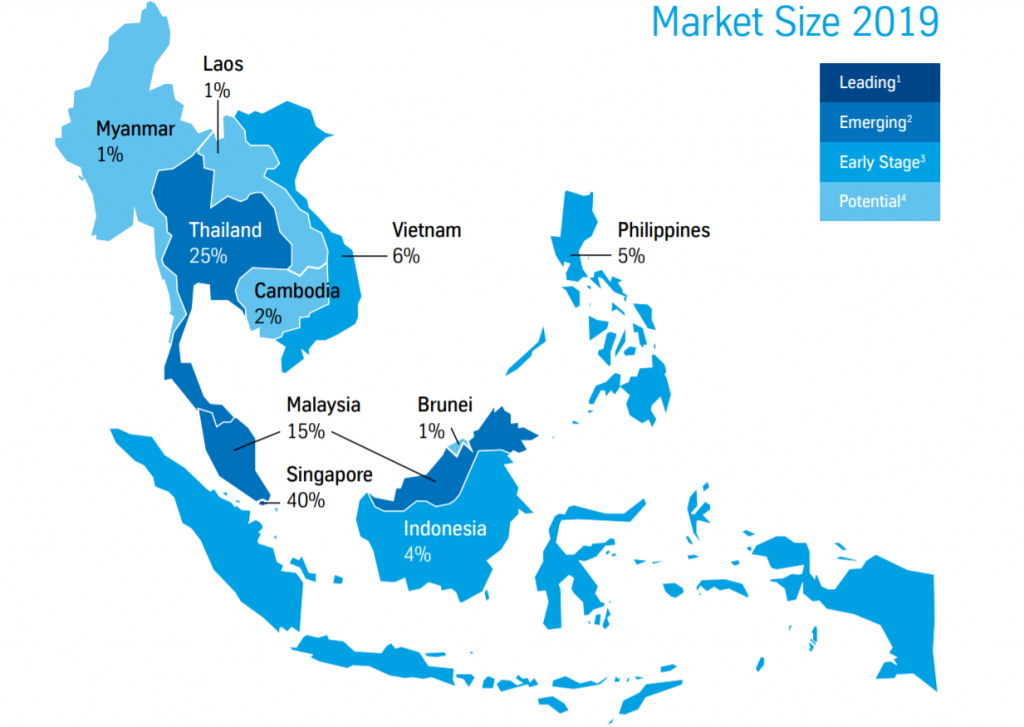
Within the ASEAN region, Singapore, Thailand and Malaysia are the largest adopters of 3D printing, accounting for around 80% of the AM market by value.
For most regions, the biggest roadblock to AM adoption today is not the technology but lack of know-how. However, AM has the potential to create more than $100 billion in value and 3 to 4 million jobs in ASEAN, according to ThyssenKrupp.
To capture this opportunity, policymakers and business leaders need to work together on implementing AM projects and providing the necessary support to build up AM infrastructure, skills and capabilities in the ASEAN countries.
Singapore as an ASEAN trailblazer in AM
Singapore has placed great emphasis on the development of the national 3D printing industry. To support the growth and competitiveness of the national manufacturing sector, Singapore’s government has established the Research, Innovation and Enterprise (RIE) 2020 plan, which identified AM as an essential enabler.
But perhaps the largest government initiative to drive AM has been the establishment of the National Additive Manufacturing Innovation Cluster (NAMIC) in 2015. NAMIC identifies and develops AM start-ups and technologies and jumpstarts public-private collaborations.
Since 2013, the Singaporean government invested $380 million through NAMIC to help it translate 3D printing research into commercial applications.
Furthermore, Singapore is home to many AM research hubs and centres of excellence, established by outside companies. Global companies like GE, ThyssenKrupp, HP, UPS, Evonik, Voestalpine and DNV GL have all set up regional AM centres in Singapore.
Local start-ups, like 3D MetalForge, Anatomics and SpareParts 3D, have been quite successful in developing AM applications and aiding penetration across industrial sectors.
AM adoption across industries
Industries that have a high potential for AM adoption, such as aerospace, marine and offshore, as well as medical technology, are well-matched to Singapore’s manufacturing base.
Singapore is thus in a good position to adopt AM technologies for improved performance and cost advantages in these industries. NAMIC puts in a lot of effort to drive such adoption, for instance, by engaging the Land Transport Authority in the use of 3D printing to make spare parts for maintenance and engineering operation of trains and buses.
Clearly, Singapore is currently ASEAN’s biggest AM knowledge centre and user that will further support the rise of the technology in the region.
Australia: A new hub for metal 3D printing
In 2019, Australia’s AM market makes up only around 3-5% of the total AM market in APAC. In adopting AM technology, Australia has lagged behind the rest of the world. However, in recent years the country has seen an influx of new companies developing AM hardware, with key examples being Aurora Labs, SPEE3D and Titomic.
Interestingly, the majority of AM developments are centred around metal-based technologies. One reason may lie in the country’s abundant deposits of natural resources, including some of the largest reserves of ores for metals such as aluminium, titanium, nickel, steel and tantalum.
This means that instead of sending a massive amount of these resources overseas, the country is looking for ways to harness these resources at home. Metal 3D printing emerges as one of the most promising technologies to process metals like titanium, nickel and aluminium.
The Australian government has been playing a positive role in fostering the adoption of AM in the country. CSIRO, Australia’s national science agency, has made a substantial commitment to 3D printing research, with an AUD$ 6 million-plus investment in its Lab 22 AM facility.
Government-funded initiatives, such as the Australian Advanced Manufacturing Growth Centre (AMGC) and the Innovative Manufacturing Cooperative Research Centre (IMCRC), have also supported the broader transition of Australia’s manufacturing industry towards higher value AM technologies.
In the meantime, some Australian firms and institutions are making significant strides in furthering AM’s use. The Royal Melbourne Institute of Technology (RMIT) founded the Centre for AM. With a range of AM technologies, including selective laser melting, direct laser metal deposition, fused deposition modelling and Polyjet, the Centre provides solutions to the aerospace, biomedical, defence and power generation industries.
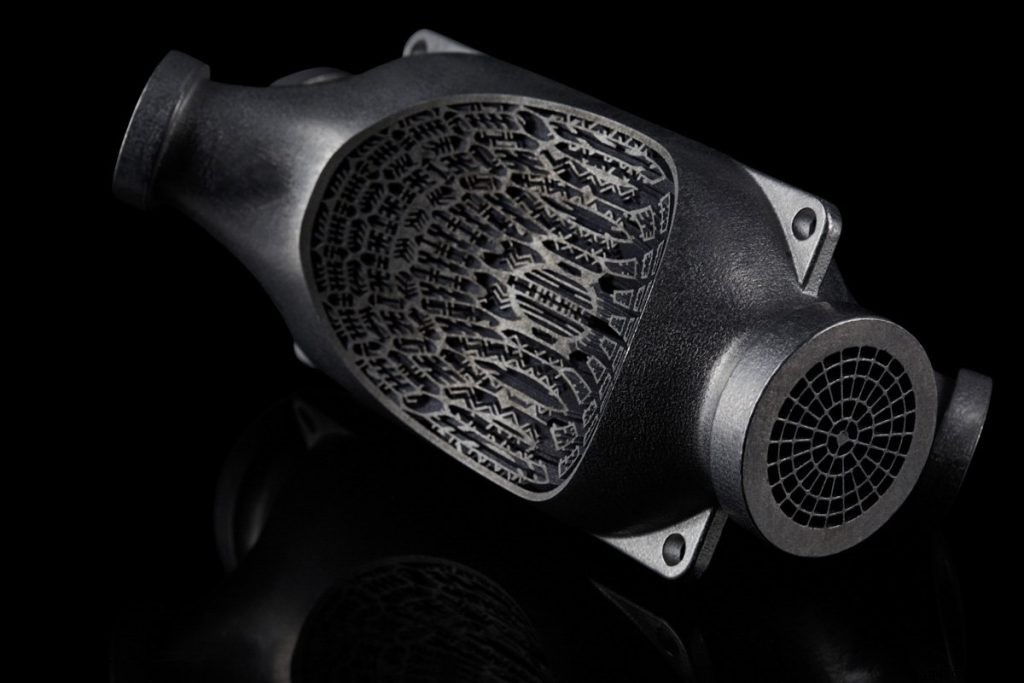
Furthermore, Conflux Technology is a great example of how companies can use AM for product innovation. Metal 3D printing helps the company to design and manufacture more efficient, optimised heat exchangers for industries, including automotive, motorsport and aerospace.
AM in Australia is also on a strong growth path for applications in the medical, aerospace and defence-related sectors.
For example, RUAG Australia is collaborating on a two-year project to investigate uses of Direct Energy Deposition (DED) technology for aircraft component repair and manufacturing.
The Australian aviation industry could benefit significantly from the research project. The Australian Air Force’s estimated total cost of replacing damaged aircraft parts is more than AU$ 230 million. Using metal AM to repair damaged parts could lower this cost dramatically.
In another example, GE Additive has signed a Memorandum of Understanding (MoU) with the New South Wales (NSW) Government in Australia, to develop a 3D printing aerospace centre at the Western Sydney Aerotropolis.
In the medical industry, iOrthotics, which specialises in custom orthotics devices, has switched from polypropylene milling to 3D printing. Investment in 3D printing solutions has allowed iOrthotics to increase its production while eliminating over 30 tonnes of plastic landfill waste annually.
AM offers an amazing opportunity for Australian businesses to differentiate themselves and be competitive. It means that the growth of this technology in the region will continue, helping to build a more competitive and sustainable Australian manufacturing industry.
APAC region: A new contender for 3D printing leadership
APAC region remains a largely untapped opportunity when it comes to adoption of 3D printing. However, the status quo changes rapidly, and the region is catching up to global leaders.
China, in particular, is growing as a serious competitor to the AM established markets in the US and Europe. China’s 3D printing industry is expected to have an output value of $7.68 billion, or one-third of the global market by 2020, according to a forecast by the China Industry Information Institute. If its growth rates continue at this pace, China could become the largest 3D printing market in the near future.
Alongside China, there is a positive outlook for South Korea and some ASEAN countries when it comes to adoption and industrialisation of AM.
Clearly, most of this growth will depend on support from governments. National governments and businesses alike should take a direction towards upbuilding a 3D printing ecosystem. Ultimately, putting key elements of policies, research, education and commercialisation together will enable national economies and industries to take advantage of advanced manufacturing technologies like 3D printing.