Membuka Pertumbuhan: Bagaimana Otomasi Membawa Sukses dalam Ekonomi Baru
Ekonomi baru saja menjadi lebih cepat.
Di lingkungan kompetitif pra-COVID, perusahaan terkemuka berfokus pada transformasi digital bisnis mereka dan pencarian serta retensi top talent yang semakin langka. Saat kita bertransisi ke ekonomi baru, imperatif bisnis yang sama tetap menjadi pusat bagi pemimpin bisnis. Namun perubahan struktural pasar yang diinduksi pandemi telah meningkatkan kecepatan gangguan pasar dan kebutuhan untuk adaptasi dan inovasi bisnis untuk bertahan.
Sebuah headline New York Times menangkap kenyataan: “CEO dipaksa untuk meragam ketidakpastian.”
Otomasi adalah penguat esensial bagi transformasi digital perusahaan dan mengelola ketidakpastian. Otomasi termasuk robotic process automation (RPA), buatan (AI), discovery proses dan tugas, dan manajemen permintaan otomasi pada platform enterprise yang kuat. Sementara diakui sebagai strategi pengeluaran biaya yang efektif, otomasi menawarkan perusahaan serangkaian nilai yang lebih luas yang relevan untuk Board, termasuk kualitas, risiko, kelincahan, dan pengalaman.
Perusahaan yang secara efektif membuka potensi penuh otomasi menemukan bahwa mereka meraih nilai lanjutan ketika kemudahan otomasi menanamkan pikiran inovasi yang diberdayakan di seluruh tenaga kerja.
Di ekonomi baru yang dipercepat, otomasi akan menjadi kunci bagi perusahaan untuk mempertahankan posisi kompetitif mereka, beradaptasi dengan perubahan pasar, dan mendominasi pasar mereka.
Konteks bisnis
Sebelum waktu
Kembali pada Januari 2020, dual fokus pemimpin enterprise adalah digitalisasi bisnis dan persaingan untuk talenta.
Menjadi digital telah menjadi “table stakes” kompetitif, sama seperti sistem ERP di tahun 1980-an.
Stratejis dan press bisnis berfokus pada aging workforce, remaining labor force’s skill gaps, dan generational divide mengenai workplace technology expectations.
COVID
Lalu COVID-19 terjadi. Dalam hitungan bulan, ekonomi dunia berubah. Persistensi varian COVID berarti kita tidak akan kembali.
Ekonomi baru
Ekonomi saat ini terlihat seperti ekonomi pra-COVID, hanya lebih cepat. Kita di dalam ekonomi baru.
Persaingan untuk talenta redux: “Great Resignation”
Sementara pasar kerja pra-COVID sempit, sempit bahkan pada 2022. Knowledge worker talent—mesin digital perusahaan—semakin langka, mahal, tua, dan gelisah. Headline terbaru menyegerakan untuk knowledge firms.
Ada 10 job openings untuk setiap seven job seekers pada akhir 2021
Emirates Airline telah melihat applicants per call center job opening drop dari 80:1 menjadi 10-15:1
Call center starting wages meningkat 33% pada 2020 dan knowledge workers’ sebesar 3.9% pada Q4 2021
Lebih dari separuh female middle managers menyatakan niat untuk meninggalkan pekerjaan saat ini pada 2022
Pada 2030, millennials akan membentuk 75% workforce
Recruiter.com’s CEO, Evan Sohn, mengatakan kepada The Wall Street Journal, “The job hopper economy tidak akan kembali.”
Great Resignation berarti firms’ knowledge, skills, dan experience sedang keluar pintu.
Firms’ inability untuk retain talent mengancam performance, competitiveness, dan speed of their digital transformation.
Digital acceleration
Leading firms telah melipat ganda digital investment. Sebuah 2021 McKinsey Global survey menemukan 37% firms berharap untuk invest more dalam digitizing end user experience selama dua tahun ke depan:
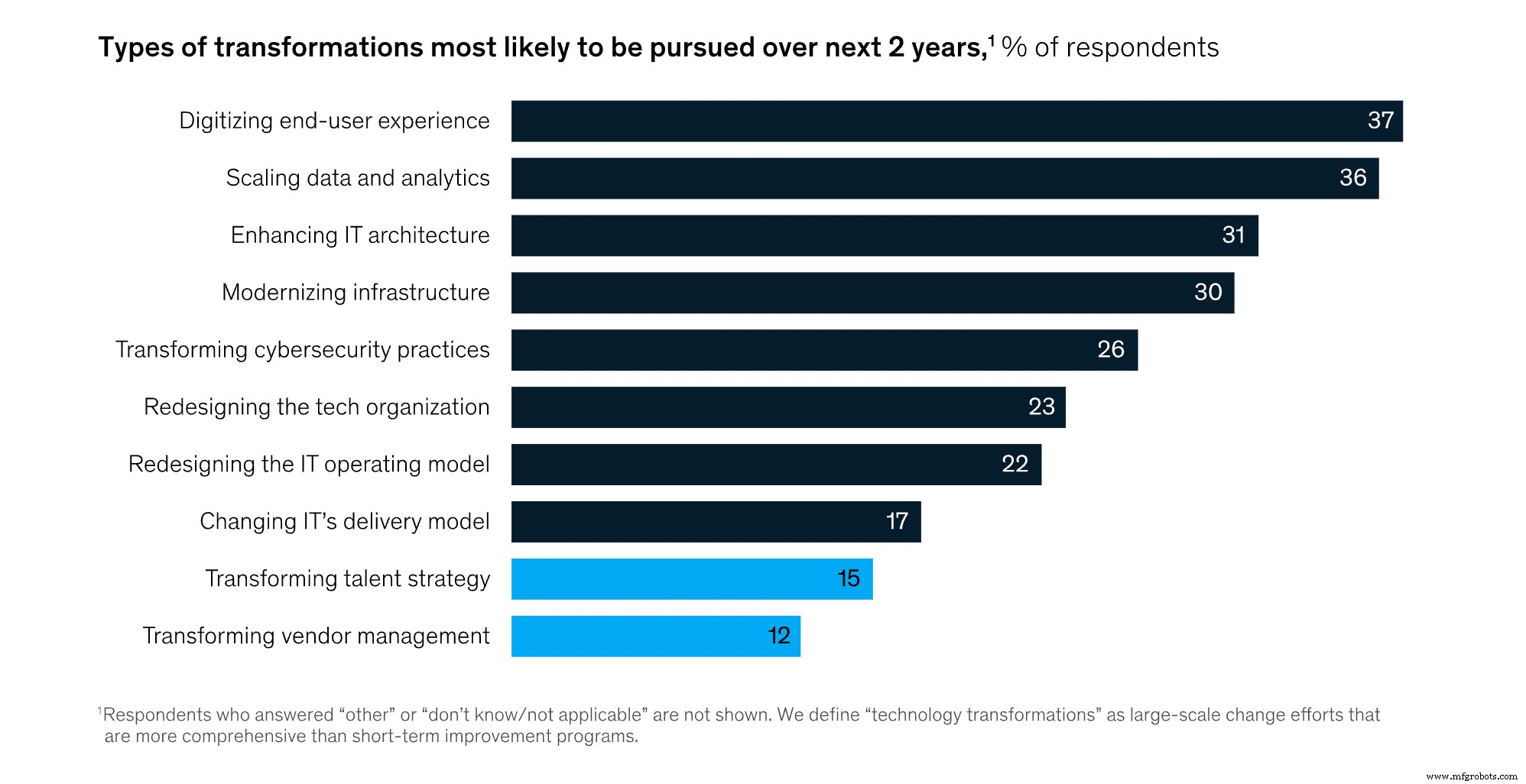
Dan bisnis tidak menunggu IT. Studi yang sama menemukan bahwa top-quartile performing firms empat kali lebih mungkin untuk have joint business- dan technology-integrated value creation models.
Otomasi, sebagai core element of digital strategy, sedang accelerating. Research suggests bahwa up to 50% of administrative work akan diotomatisasi pada 2030. Sebuah 2019 global shared services survey menunjukkan shift to knowledge work, as purely transactional work increasingly automated away.
Ya, itu adalah suara competitors’ footsteps yang Anda dengar di belakang Anda.
Accelerating rate of disruption
COVID meningkatkan rate of change dan disruption. Elapsed time dari disruptive technology introduction ke ubiquity dropped 50% in 40 years (lihat Figure 1).
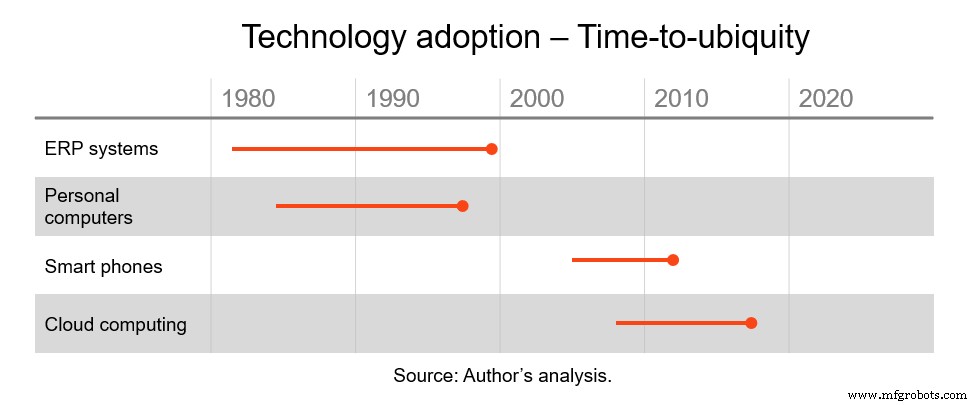
COVID mengubah location of work untuk banyak orang hanya dalam beberapa minggu. Headlines suggest ini mungkin permanen. Assumption of markets’ multi-year stability dan predictability tidak lagi berlaku. Key global market indicators semua menunjukkan rising volatility:
The International Monetary Fund World Uncertainty Index tumbuh tajam sejak 1990
Economy-disrupting natural disasters di United States (U.S.) meningkat 315% sejak 1990
Global supply chains tidak dapat diprediksi dan mahal, dengan increases hingga 500% pada 2021
Dan, pada saat ini ditulis, yet unknown consequences of Russia’s war on Ukraine.
Agility adalah competitive advantage dan minimum condition untuk survival di new economy.
Automation’s value
Automation menyediakan three value levers:
Productivity: reduction in non-value-added labor
Quality: reduction in error rates
Speed: improvements in cycle times
Value levers ini memiliki broad application untuk deliver Board-relevant value across five dimensions: cost, risk, agility/speed, experience, dan innovation (lihat Figure 2).
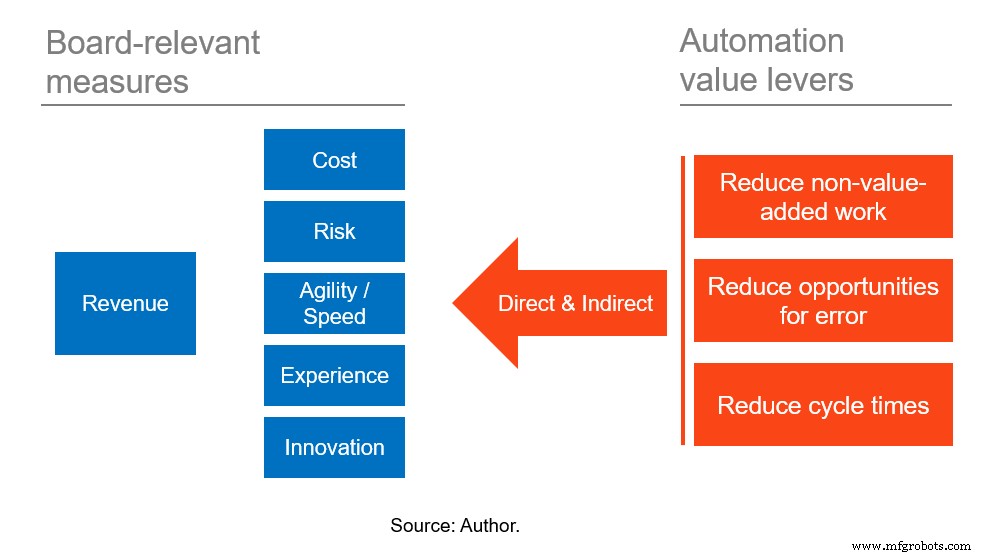
Mari kita review automation’s potential di setiap dimensi value ini.
Cost
Reducing non-value-added human labor adalah paradigmatic value of automation. Melalui automation, jumlah (dan cost) human labor yang sama dapat lebih produktif, sehingga improving cost of goods sold (COGS) atau sales, general, dan administrative (SG&A) costs.
Dimana dan bagaimana automation-derived productivity savings ‘dibanked’ tergantung pada firm’s—dan seringkali specific operating unit’s—immediate challenges. Productivity savings dapat dibanked sebagai:
Headcount reduction labor savings
More process throughput dan revenue dengan unchanged labor cost structure
Productivity savings dapat dibanked dengan releasing fractional portions of existing labor’s time untuk perform other work yang tidak dapat diukur langsung dalam process throughput.
Released capacity ini dapat substitute for costs of seasonal flex capacity atau consulting services, providing savings to firm, meskipun seringkali pada different budget line.
Risk
Risk adalah cost yang belum mengenai balance sheet. Belum.
Automation’s improved quality value lever mengatasi contractual, regulatory, dan reputational risk. Automation tools menghapus repetitive, predictable, error-prone steps dari human action. Semakin sedikit opportunities for error dalam end-to-end process, semakin sedikit errors yang mungkin terjadi. As decades of process improvement studies have demonstrated, you can pay a little for quality up front atau pay a lot to fix poor quality later—seringkali lima kali lebih banyak.
COVID menunjukkan bahwa bad things terjadi pada good firms yang tidak resilient. Organizational resilience berasal dari overall simplicity dan transparency dari business model dan processes. COVID dan supply chain disruptions menunjukkan kebutuhan untuk end-to-end process transparency. Firms tidak lagi mampu afford “black box” steps di value chain mereka.
Automation tools, termasuk task mining dan process mining, membantu firms mitigate value chain risks, termasuk business process outsourcing (BPO) dan key person risks. Task dan process mining tools capture end-to-end dan cross-system processes dan implicit knowledge yang hanya few seasoned workers punya.
Further, unlike many BPO contracts, automation robots dapat handle dramatic changes in transactional volumes tanpa performance failures dan tanpa cost penalties.
Agility
Agility adalah firms’ ability untuk change quickly dan deftly as market changes pose threats dan time-sensitive opportunities. Automation menyediakan faster time to value, when business processes harus change.
Setiap firm relies on complex array of enterprise transactional systems: customer relationship management, sales, supply chain, procurement, manufacturing, logistics, service, finance, dan human capital management. End-to-end seamless process integration lintas transactional systems secara inherent complex. Ideally, cloud computing dan API architecture menyediakan seamless enterprise architecture integration. Yet, seringkali business needs outpace technology team’s ability to deliver. New economy, dengan increasing rate of change, exacerbates IT backlog issue, forcing IT untuk say “no” to more legitimate, tetapi lower priority, requests.
An automation platform menyediakan low complexity overlay untuk enterprise transactional systems yang memungkinkan IT untuk address more business change demand lebih cepat, tanpa menambah enterprise technology stack complexity.
A low-code integration lintas siloed systems dapat dikembangkan, diuji, dan diterapkan dalam minggu. Same change dilakukan di two atau more enterprise application teams mungkin membutuhkan bulan atau kuartal.
Time adalah money di new economy.
Experience
Automation’s quality dan speed levers secara langsung berkontribusi kepada customer dan employee experience value.
Customer experience
Customers yang experience first-time right processes dan faster start-to-finish times akan more satisfied dan more loyal. Reductions in error rates correlate dengan improved customer satisfaction. Similarly, improved call dan service request resolution times contribute kepada customer satisfaction (CSAT) metric improvements.
Improved CSAT yields increased revenue melalui upsells to existing customers dan reputation-based sales expansion to new customers.
Di cost side, improved CSAT reduces customer attrition, thereby reducing customer acquisition costs.
Employee experience
Demikian pula, automation’s contribution to employee experience adalah direct dan indirect, tetapi real. Automation yang removes tedious, repetitive, rote manual work meningkatkan employee experience dan meningkatkan employee engagement. Ini memiliki measurable bottom-line impact to firms. Brookings Institute research found:
Employees yang experience their work as meaningful kurang mungkin call in sick, more likely participate in skills training, dan want postpone retirement
A sense of autonomy dan relatedness to work adalah most important drivers of employees experiencing their work as meaningful— 20 kali lebih penting dari pada income
McKinsey& Company research found bahwa when employees find their work meaningful:
They are 75% more committed to organization
dan 49% less likely to leave.
Reduction in undesired attrition adalah direct cost savings. Full replacement costs of an employee ranges dari about 35% of annual salary untuk call center agent hingga 150% untuk senior manager atau technologist. These hard dollar costs include recruiter time, hiring bonuses, training costs, initial lower productivity, dan temporary labor atau overtime vacancy coverage.
In addition to lower attrition rates, engaged employees contribute more value—they are 33% more productive on average. As one chief human resources officer aptly put it: “The point of employee engagement adalah untuk unlock discretionary effort—employees going above and beyond” (quoted in Jacob Morgan, 2017, The Employee Experience Advantage, emphasis added). This brings us to last value dimension of automation: innovation.
Innovation
Automation memungkinkan firms untuk shift ke pervasive innovation culture. Innovation dapat terjadi di any level of firm dan any functional area of firm if management enables it. The Toyota Way transformed manufacturing work. It was premised on listening to dan empowering line workers’ improvement ideas. Same holds true for knowledge work.
The sum of innovation: 1 + 1 = 2
Smaller value contributing ideas masih accretive to firm, if captured. Low-code citizen developer solutions dramatically reduce cost of solution delivery, lowering these small automation business cases’ ROI threshold. Further, citizen developer model places automation labor cost burden onto business unit yang akan gain value of automation, while reducing IT backlog.
Related article: Understanding Citizen Developers: Your Secret Weapon in Scaling Automation
Often, line workers’ value accruetive ideas are not addressed because individually, their value contribution tidak rise to level of firm-wide financial materiality. This can have adverse effect of creating “culture of ‘no’,” as one business leader described it. Employees bring forward innovation idea dan answer adalah “While that makes sense, from corporate point of view, it is not that important—no.” Shadow IT pockets are evidence of such systematic disconnects between what business units need dan value dan what IT has capacity to provide.
In a culture of no, workers stop offering innovation ideas, disengage dan limit their discretionary effort. Lower productivity follows. Recent research shows bahwa laggard firms haven’t made low-code, citizen development automation tools pervasively available. In one Bain-UiPath study, 86% of employees were willing to use automation tools, but only 14% were provided opportunity. Download full report.
An empty staff “suggestion box” is evidence of a culture of no dan warning sign to any firm dependent on innovation to survive dan grow.
When done pervasively across a firm, sum of these incremental innovations becomes Board-relevant in size.
Importantly, putting automation technology solutions in hands of wider sphere of employees can fundamentally change innovation value equation.
The product of innovation: 1 x 2 x 4 x n = 10ˣ (creating “culture of yes”)
Automations dapat dirancang dan diterapkan dalam minggu. Line staff dapat see results of their innovation work in few months. Management dapat see results in same fiscal year. This is positive feedback loop yang drives staff engagement, entrepreneurial spirit, dan creative problem solving. It creates “culture of yes.”
A culture of yes empowers departments, teams, dan even individuals untuk solve their business process problems quickly, easily, cheaply, dan self-sufficiently, leveraging low-code/no-code automation, task mining dan process mining tools. This culture welcomes line workers’ innovative ideas dan enables pervasive innovation in firm.
A telecom executive described tangible value of this culture change at his firm: “When you give people these tools, they start sharing ideas they have been holding back on. Maybe not first atau even second idea is material [at enterprise level], but eventually that person will offer improvement idea that will really move needle.”
A culture of yes indicates pervasive innovation mindset that is basis of 'needle moving' geometric returns on investment.
Summary
New economy is like pre-pandemic economy . . . only faster.
Firms’ focus on digital business models, talent, dan innovation have only increased. UiPath provides automation platform untuk drive digital initiatives; attract, retain, dan motivate top talent; increase agility; reduce risk; dan create pervasive innovation culture of yes.
No one any longer questions employees’ need for email to do their jobs. With new economy’s focus on digitization, talent, speed, dan innovation, soon no one will question employees’ needs for robot assistants to help with their jobs. Robots are new email.
“U.S. Economy Poised to Be More Productive” read recent Wall Street Journal headline.
Yes, those are your competitors’ footsteps you hear. It’s time to accelerate.



