11 Teknik Pengecoran Logam Terbukti untuk Manufaktur Presisi
Pelajari istilah dan proses yang terlibat dalam menarik harta karun dari api tungku
Apa itu pengecoran logam?
Pengecoran logam adalah proses pembuatan objek dengan mencurahkan logam cair ke dalam ruang kosong yang dibentuk. Logam kemudian mendingin dan mengeras menjadi bentuk yang diberikan oleh cetakan tersebut. Pengecoran seringkali merupakan cara yang lebih murah untuk memproduksi bagian dibandingkan memotong bagian dari potongan logam padat. Ada banyak metode pengecoran logam yang dapat dipilih. Jenis pengecoran mana yang paling efisien tergantung pada logam yang digunakan, ukuran luncuran, dan kompleksitas pengecoran.
Sebelum memulai luncuran produksi, berguna untuk mengetahui beberapa istilah dan metode dari lantai pabrik cor.
- Lompat ke Terminologi Pengecoran
- Lompat ke Jenis Pengecoran Logam
Terminologi pengecoran
Cetakan pengecoran
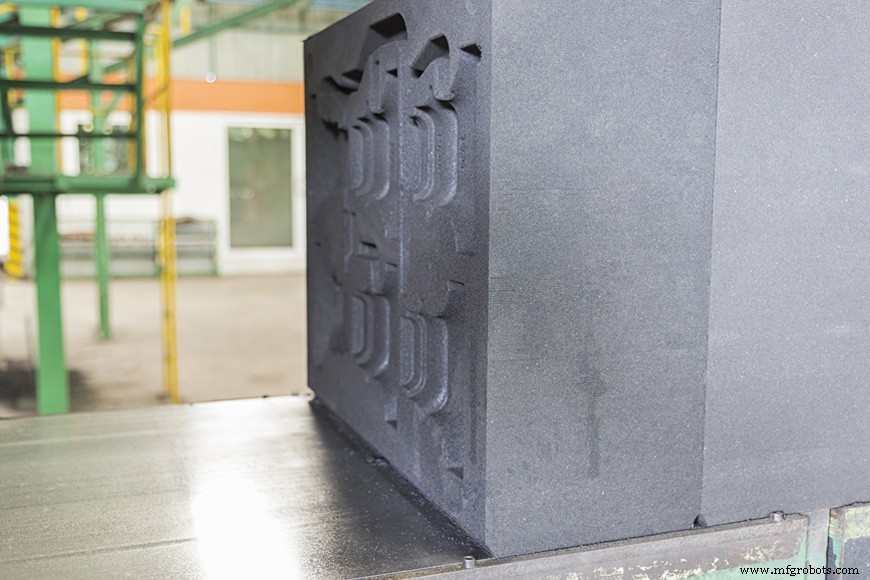
A cetakan adalah rongga dalam material yang menerima logam cair dan menghasilkan objek mendingin dalam bentuk rongga tersebut. Cetakan dapat sederhana. Bentuk yang digunakan untuk membuat ingot logam seperti loaf pan, dengan logam dengan hanya dicurahkan di dalam dan dibiarkan mendingin. Sebagian besar cetakan untuk bentuk yang lebih kompleks dan didasarkan pada pola. Pola dicetak ke dalam cetakan terbagi. Setengah pola dicetak di satu sisi cetakan dan setengah di sisi lain, dan kemudian setengahnya dipadatkan bersama sebelum cetakan diisi. Dengan membuat cetakan dalam dua bagian, pola dapat ditarik sebelum diisi. Cetakan ini dapat dibuat dengan split horizontal
Cope and drag
Dalam pencetakan horizontal, setengah atas cetakan disebut cope, dan setengah bawah disebut drag.
Swing and ram
Dalam pencetakan vertikal, setengah depan cetakan disebut swing, dan setengah belakang disebut ram.
Molding cores
Jika cetakan seharusnya memiliki ruang internal atau lubang, sebuah inti sering dibuat. Inti ini dibentuk seperti ruang internal. Inti biasanya dipegang dengan cara melebihi cor dan dipegang melalui core prints, yang menggantung inti seperti jembatan antara dua tepi. Ruang kosong di sekitar inti akan terisi dengan logam, dan inti akan dikeluarkan dari cor akhir, meninggalkan lubang di mana inti pernah berada. Jika inti sangat panjang, mungkin didukung oleh chaplets untuk mendukungnya. Ini biasanya terbuat dari logam yang sama dengan cor akhir karena mereka duduk di ruang yang akan terbanjir dengan material dan menjadi bagian dari cor akhir.
Dimensional tolerance
Salah satu faktor penting dalam memilih metode pengecoran adalah dimensional tolerance. Dimensional tolerance adalah variasi yang dapat diterima dalam ukuran produk akhir. Logam menyusut saat mendingin, dan jenis pengecoran mempengaruhi seberapa banyak. Jika produk perlu akurat, klien mungkin ingin metode pengecoran yang menghasilkan near net casting. Ini berarti produk sangat dekat dengan ukuran yang benar saat diambil dari cetakan.
Surface finishing
Pertimbangan lain adalah surface finishing. Seberapa kasar, bergerindil, atau kasar permukaan cor dapat? Yang dapat diterima untuk wajan cast iron tidak dapat diterima untuk cincin pernikahan. Permukaan logam yang sangat halus biasanya dibuat dengan machining, yang merupakan biaya tambah: jika halus dan licin adalah hasil yang diinginkan, memilih metode pengecoran dengan finishing yang lebih halus dapat mengurangi biaya machining.
Pengecoran logam ada dalam dua kategori utama: proses dengan cetakan yang dapat digunakan ulang dan proses dengan cetakan sekali pakai.
- Cetakan yang dapat digunakan ulang:
-
- Permanent molds
- Semi-permanent molds
- Slush casting
- Centrifugal casting
- Pressure casting
- Die casting
- Cetakan sekali pakai:
-
- Sand casting
- Shell molding
- Investment casting (lost-wax)
- Full mold or foam
Cetakan yang dapat digunakan ulang atau permanent molds membuat banyak item, sedangkan cetakan sekali pakai hancur oleh proses pengecoran. Meskipun dari perspektif lekat mungkin tampak cetakan yang dapat digunakan ulang harus lebih hemat biaya untuk luncuran produksi besar, ini tidak selalu benar. Sebagian besar objek besi dan baja dibuat melalui proses pengecoran sekali pakai.
Bahan cetakan suhu rendah (resin, cokelat, lilin, dll.) hampir selalu menggunakan cetakan yang dapat digunakan ulang. Apa yang membuat metalurgi berbeda adalah suhu tinggi yang terlibat. Ini memberikan banyak beban pada cetakan. Oleh karena itu, tidak heran jika logam dengan titik leleh lebih rendah seperti seng, aluminium, magnesium, timah, atau tembaga lebih sering berhasil dalam proses pencetakan yang dapat digunakan ulang.
Namun, dalam beberapa hal, bahkan logam ferro dicurahkan ke dalam cetakan yang dapat digunakan ulang. Kompleksitas desain, pilihan logam, dan persyaratan untuk dimensional tolerance dan surface finishing semuanya mempengaruhi apakah cetakan yang dapat digunakan ulang cocok.
Cetakan yang dapat digunakan ulang
Permanent molds
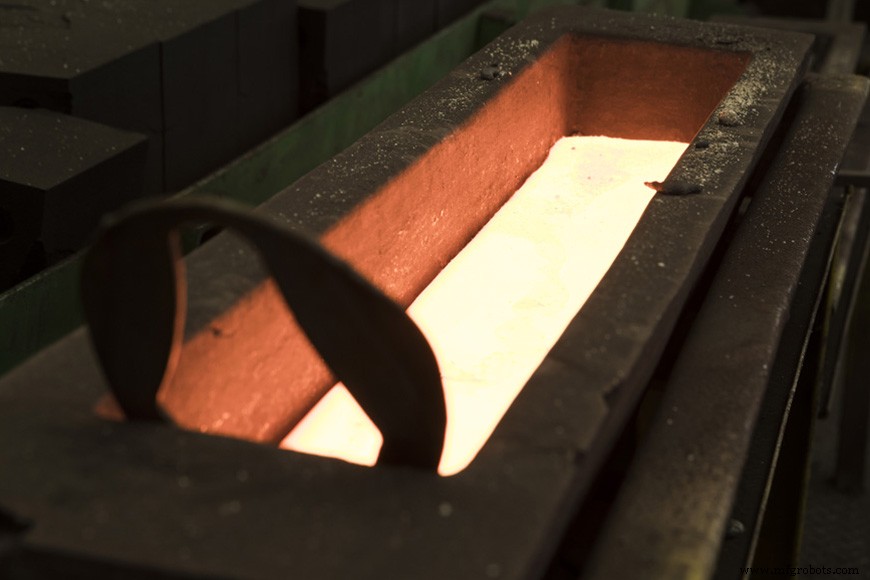
Permanent molds biasanya terbuat dari logam—salah satu yang memiliki titik leleh lebih tinggi daripada logam yang diisi. Fluid logam dicurahkan tanpa tekanan eksternal. Permanent cores harus sederhana sehingga dapat ditarik untuk digunakan kembali dari cor yang selesai.
Cetakan ini terkadang digunakan dalam pengecoran besi, serta dengan logam suhu rendah. Turntable, alih-alih assembly line, adalah alur kerja industri paling umum. Operasi individual, seperti melapisi cetakan, menempatkan inti, menutup cetakan, mencurahkan, membuka cetakan, dan mengeluarkan cor, dilakukan saat setiap cetakan melewati stasiun berikutnya.
Cetakan dipanaskan sebelum cor pertama dicurahkan sehingga tidak pecah karena selisih suhu.
Cor yang berasal dari metode ini tidak dapat memiliki dinding setipil yang ada dalam metode reusable lainnya, seperti die casting. Namun, cor dihasilkan dengan “close tolerance,” yang berarti ukuran cor akhir dapat diprediksi dengan lebih akurat. Cor yang dibuat dengan cara ini padat dan butir halus. Mereka memiliki finishing permukaan yang lebih halus dan menghindari beberapa jenis cacat.
Bentuk pencetakan ini cukup tahan lama untuk digunakan dengan besi, tetapi ini bukan gaya yang disukai untuk kuningan kuning. Kuningan kuning tinggi dalam seng dan kotori cetakan atau die.
Semi-permanent molds
Perubahan satu-satunya dalam semi-permanent mold casting adalah inti yang digunakan dalam proses pengecoran mungkin adalah inti pasir sekali pakai. Bentuk inti yang lebih kompleks mungkin dengan inti pasir, karena mereka tidak perlu diekstrak utuh dari cor akhir. Jika pembukaan di cor diabaikan untuk mengeluarkan inti, mereka dapat “di-goyang” pada meja getaran, untuk mengalir seperti pasir melalui jam pasir. Keuntungan toleransi, kepadatan, dan penampilan permanent mold casting hanya ada pada bagian yang dicetak terhadap cetakan logam.
Slush casting
Gaya pengecoran yang dinamakan warna ini menciptakan cor berongga tanpa membutuhkan inti dengan hanya melapis dalam cetakan dengan jumlah kecil logam, menciptakan “kulit” logam. Ada berbagai cara untuk pendekatan slush casting tergantung pada seberapa cepat logam atau material lainnya mengeras. Dalam satu metode, pabrik cor dapat mencurahkan jumlah kecil cairan ke dalam cetakan dan memutar untuk melapisi dalam dengan logam. Dalam metode lain, pabrik cor dapat mengisi cetakan sepenuhnya dan kemudian mencurahkan sisa material setelah waktu pendinginan tertentu. Seng, aluminium, dan pewter adalah logam yang biasanya di-cast slush.
Centrifugal casting
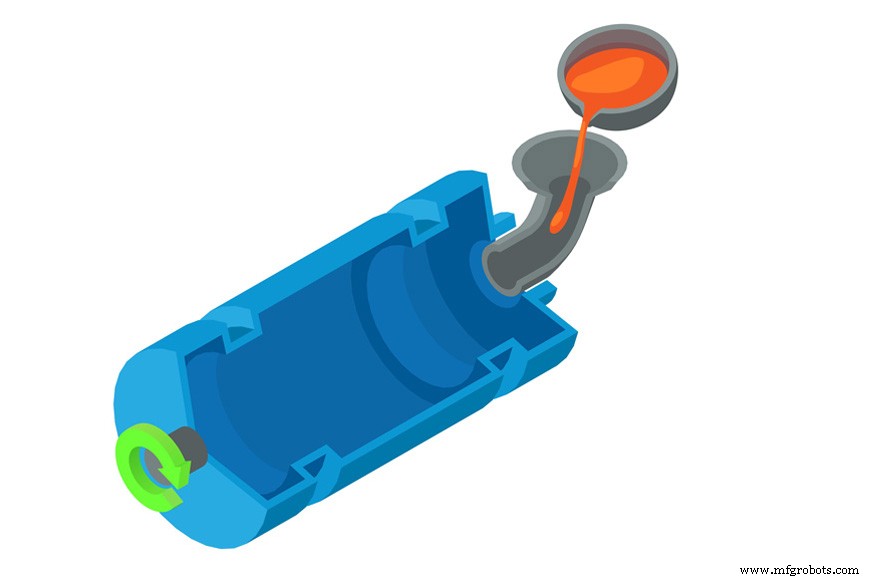
Dalam true centrifugal casting, cetakan pendingin air diputar di sekitar sumbu pusatnya dengan kecepatan tinggi sementara logam cair diumpankan. Gaya sentrifugal menarik logam cair di sepanjang permukaan cetakan dalam lapisan merata. Agar metode ini bekerja, cor akhir harus memiliki geometri yang merata di sekitar sumbu putar. Bentuk pengecoran ini oleh karena itu terbaik untuk cetakan yang kira-kira silinder atau bulat, seperti tabung atau cincin.
Objek yang dicor dengan metode ini biasanya memiliki tingkat cacat yang sangat rendah. Impurities akhirnya dekat dengan lubang, atau permukaan dalam, cor, dan dapat di-machining. Sebagian besar pipa atau fitting yang akan digunakan di bawah tekanan dicor secara sentrifugal, karena kekuatan struktur seamless mereka.
Beberapa cor logam kecil, seperti perhiasan, dibuat menggunakan centrifuge yang memutar seluruh cetakan di sekitar titik pusat, menarik logam dari crucible saat berputar. Cor ini bukan true centrifugal castings, tetapi bentuk pressure casting.
Pressure casting
Pressure casting methods use forces other than gravity to control the flow of metal into a permanent mold. Air or gas, vacuums, mechanical, or centrifugal forces are all used in pressure casting. These methods allow foundries to precisely control the rate at which a mold fills: gravity always works with the same force, but man-made forces can be varied.
Vacuum casting pulls metal into a mold when the mold is depressurized, and the vacuum created pulls liquid metal up from a reservoir below. The vacuum must stay on while the metal cools, and so this method is mostly used for thin walled castings. It provides excellent surface finish. Low pressure castings invert this process by pressurizing the furnace where the liquid metal sits, rather than creating a vacuum in the mold. The metal is pushed through risers into the mold cavity.
All die casting machines (below) also use some form of pressure to help create castings.
Die casting
Die casting machines consist of a basin holding molten metal, a metallic mold or die on two plates, and an injection system that draws the material and forces it under pressure into the die.
The process for die casting starts with an open mold. Nozzles spray the mold with a lubricant to help prevent the part from sticking. The two halves of the mold are then closed, and the closed mold is injected using a pressure nossle. The new casting is given a moment to cool before the die opens. Ejector pins push the new casting from the die, and then the process starts again.
There are two forms of metal injection in die casting. Cold-chamber die casting works like a syringe: before each die is cast, an injection chamber must be filled with molten metal, and then a piston pushes the injector’s contents into the die. Hot-chamber or gooseneck die casting works by immersing the chamber of the injection system into the molten metal, where the shape of the system means the injector refills itself. Hot-chamber die casting pushes this material into the mold either with a piston or with air pressure.
Gooseneck systems are more prone to corrosion because they sit in a bath of melted metal. For this reason, they’re usually used with aluminum or aluminum-zinc alloys that have a lower melting point. The piston or cold-chamber injection die caster can be used for the higher temperatures needed to melt brass and bronze, because the injector is not continuously exposed to the heat.
Continuous Casting
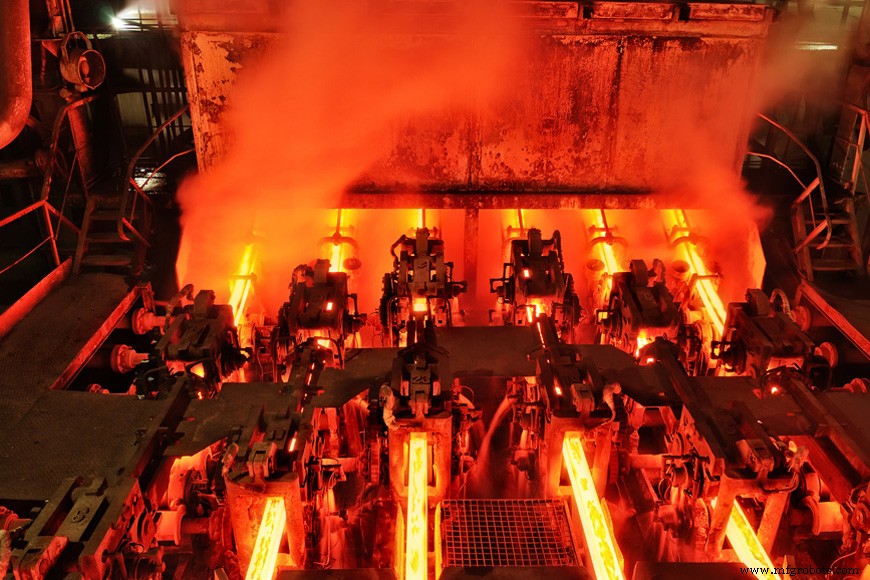
Even metal parts we consider completely machined, rolled, or otherwise worked have often had their start on the foundry floor. Continuous casting creates blooms, billets, and slabs, which are different sizes of simple metal shapes, by extruding them through a permanent form. This casting process creates the raw material for worked steel.
The continuous casting process starts high above the factory floor. Molten metal is fed into a funnel that controls the rate of casting. The funnel fills a mold below it, which is a simple form, usually 20-80 inches long, and shaped on its width like a square, circle, or rectangle. The mold walls are cooled so that the exterior of the casting freezes as it passes through. As the metal leaves the form it is solidifying, but still pliable. This allows the continuous casting machine to bend it so that the finished produced comes out horizontally. A series of wheels guide the slab to a conveyer belt while cooling sprays solidify the surface. Gas jets on the horizontal surface cut the continuous metal piece into manageable lengths, so they can be lifted and stacked.
Expendable molds
Expendable mold methods are the clear winners when it comes to casting ferrous metals. They are cost effective because they do not have to be sturdy for the high temperatures involved.
Sand casting
Sand casting is the most common method used for metal casting. It is manufacturing process at least three thousand years old: the first evidence of clay casting comes out of China, during the Shang Dynasty (c. 1600 to 1046 BC).
It is no wonder this process is still so popular: sand is cheap, plentiful, pliable, and able to take the heat.
Cores created out of sand are easy to remove: they can be shaken out with a vibrating table. Runners and gates, used to direct the metal into the mold cavity, are either cut by hand by an experienced molder or are created as part of the pattern.
The surface finish on sand cast items is often rough, and the dimensional tolerance not precise, so sand casting is great for producing large, rugged pieces from decorative fences to cast iron pans to car engine parts.
Read more about sand casting in our previous article in this series.
Shell molding
Shell molding is a form of sand casting that provides closer dimensional tolerances. It’s very similar to sand molding, only the sand is mixed with a resin. A mixture of sand and resin are poured over each half of hot metal molding pattern. This mixture melts and cools into a shell. The “shells” of the mold are brought together, and usually supported by a flask full of sand. With the resin providing extra support to the interior surfaces, these shells form a very precise mold.
Often, shell molding is used to produce cores for traditional sand casting. The resin gives the sand cores strength to keep shape, even when positioned over the void that will become a casting. These shell cores may be hollow, created in a hot metal mold in a process like slush casting. The two halves of the core mold are clamped and heated, and then filled with resin coated sand. The mold bakes until the shell wall is thick enough to support the size of the core and then the excess, uncured resinous sand is poured back out. When the two halves of the mold are split they reveal the sturdy core, now ready to be placed in the sand-casting mold create space in the casting.
-
Investment casting (lost-wax casting)
Sand casting is by far the most used form of metal casting, and yet there is one aspect of sand casting that makes it inappropriate for some projects. Sand casting patterns need to be removed from the mold they create, which can mean intricate pattern construction. Draft requirements, parting line placements, gates, risers, and cores require a pattern maker to carefully consider the pattern’s needs at each stage in the casting process.
The lost-wax, investment, or precision-casting process is an alternative to sand casting that can work with most grades of metal, even high-melting point ferrous alloys, and yet avoids some of these challenges of patternmaking in sand casting.
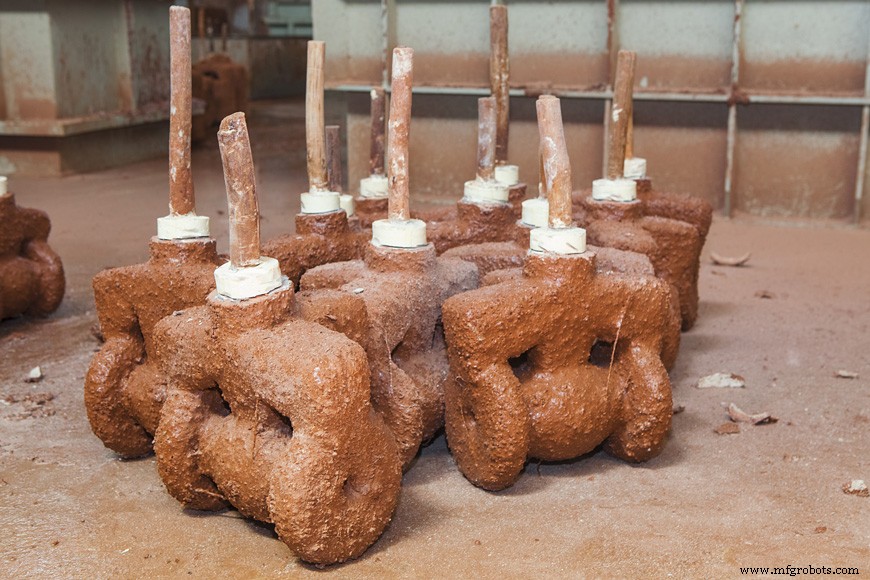
A designer for an investment casting makes an accurate metal die into which the wax or plastic patterns are cast. These patterns are assembled on a sprue also made of this material: the foundry worker uses a torch to melt the sprue enough to attach each pattern to it.
This assembly is then used to create a shell that will be used as the mold. It is sprayed, brushed, or dipped in a slurry of a fine-grained, highly refractory aggregate, and a proprietary bonding agent composed chiefly of ethyl silicate. This mixture is then allowed to set. The pattern is coated repeatedly with coarser slurries until a shell of the aggregate is produced around the pattern. The molds stand until the coating has set, after which they are heated in an oven in an inverted position so that the wax will run out and be collected for reuse. After the wax is removed, the molds are baked in a preheated furnace. The molds may then be supported with loose sand and poured in any conventional manner.
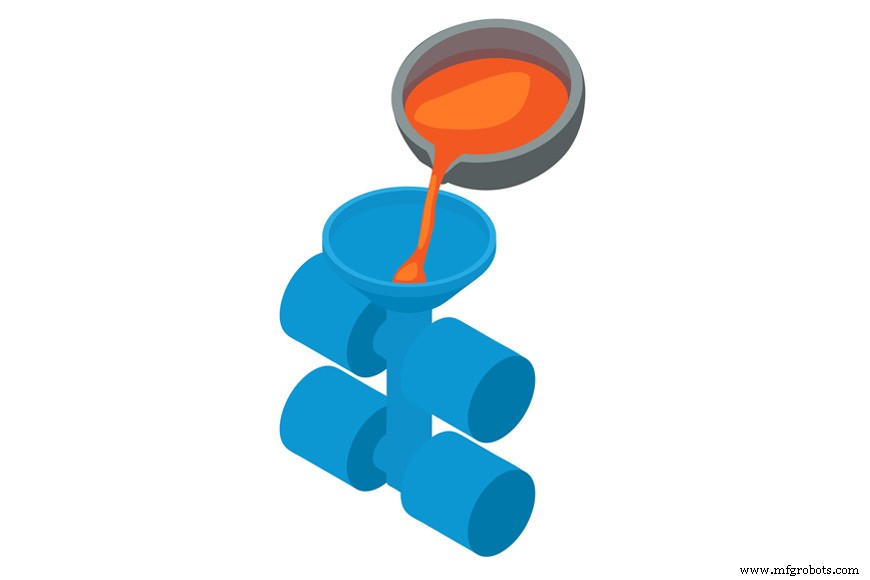
When the castings have cooled, the shell around the investment casting is broken and shaken off using a vibrating table.
Investment casting provides superior surface finish, and high dimensional accuracy. There are no parting lines like there are in sand casting.
Full mold or foam casting process
The full mold or foam casting process is a combination of sand and investment cast processes. A foamed polystyrene pattern is used. Indeed, the foamed pattern may be made complete with a gating and runner system, and it can incorporate the elimination of draft allowance. Sometimes the pattern is removed prior to filling, but with some foams the pattern can be left in place in the mold to instantly vaporize when hot metal is poured in.
This process is ideal for casting runs of one or a few pieces, but sometimes foundries mass-produce foam patterns to create production quantities. There is extra expense for the equipment to make the destructible foam patterns, but often the economics of the total casting process can be favorable if the pattern is very complex.
Comparing casting processes
Consultation with manufacturers is helpful to find the most cost-effective way to cast a project. In general, ferrous metals will be cast using expendable molds, whereas non-ferrous metals have a wider range of possibilities, but there are exceptions even to this simple rule.
Going into the process with a clear understanding of the project’s needs will help choose the best process for casting. Does the design need to be a precise size? How thin do the walls need to be? What size and weight will the casting be in the end? What about the surface finish? Knowing in advance the answers to all these questions will help a savvy designer understand and guide their product through the casting process, finding the best, and least expensive, process to do their job.
Previous Post: Prototyping Metal Casting Process Next Post: Sand Casting



